AI may not take the job first. It may take the tool switching.

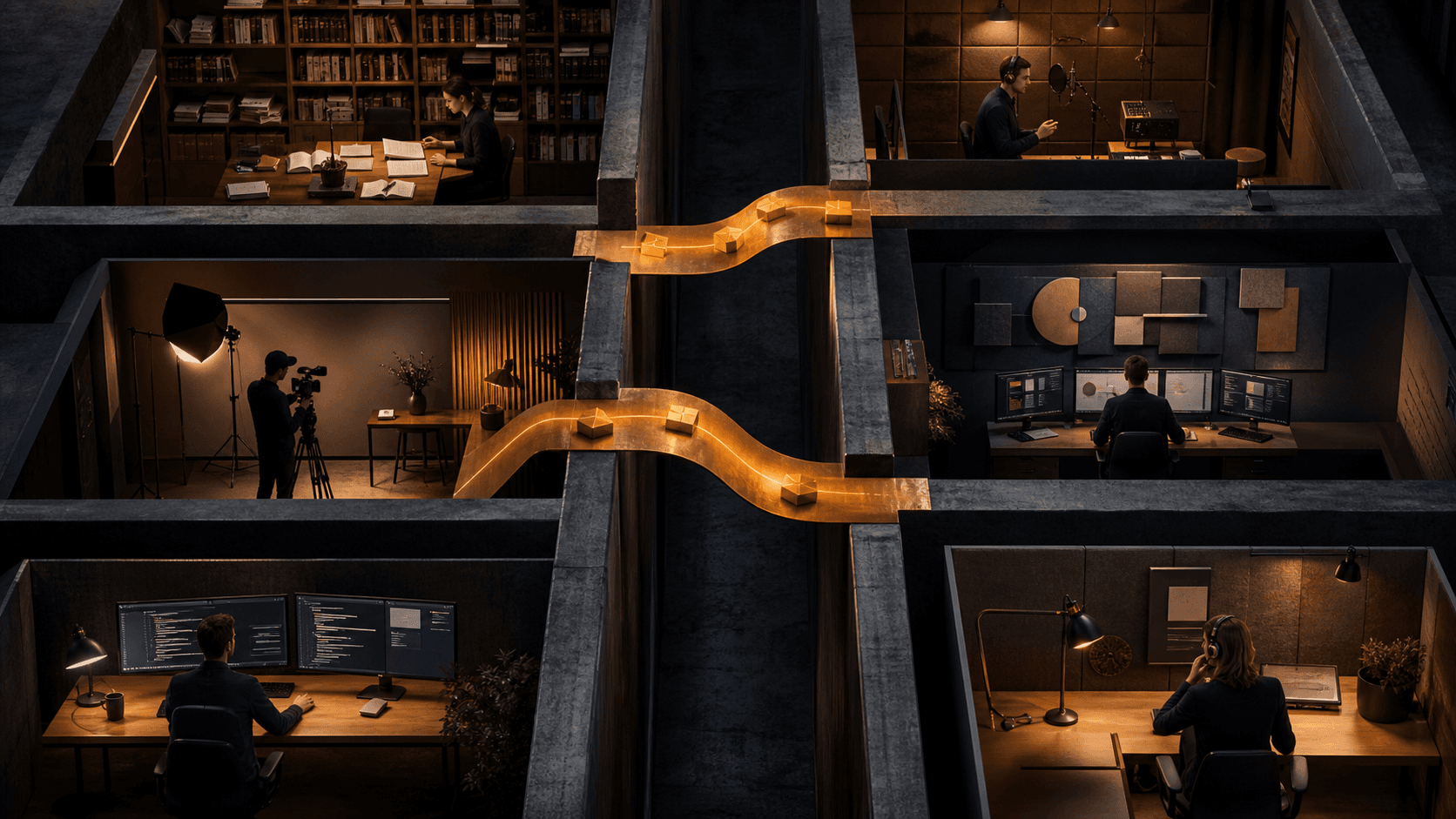
The AI industry likes to talk about entire professions disappearing. Week 35 pointed to a less dramatic, more immediate change: the tool switching started to disappear.
By coordination tax, we mean the time spent finding the right file, moving facts between systems, changing formats, checking status, and handing work to the next person. That is not the same as expertise. It can still consume a large part of the day.
This week's signals from Mistral, Perplexity, xAI, Google, OpenAI, and Anthropic support a clear thesis: AI is likely to absorb the gaps between people's tasks before it replaces the people who know the work. If that thesis is right, companies should start by measuring waiting time and handoffs, not promising rapid headcount cuts.
This week's AI race is about the gap between two tools
A business process can look simple on a flowchart. In practice, someone waits for an attachment, copies a customer number, renames a file, requests access, or rewrites the same material for another system. Each step is small. Together, they create expensive friction.
That is where vendors are moving. They no longer sell only a better answer. They are trying to let AI find the material, keep the context, choose the right specialist service, and carry the result to the next place.
This makes the labor question more concrete. The first task to disappear may not be the analysis, the customer meeting, or the creative decision. It may be the seven minutes between them.
Perplexity and Grok move work to where it already happens
Perplexity introduced managed connectors for services including GitHub, Slack, Google Drive, and Datadog. Perplexity Computer can also be reached through email and MCP. Search no longer has to be a separate destination. It can begin in an email, retrieve material from a private system, and return a finished work product.
xAI is moving in the same direction from another angle. Grok Bot reached lower-cost self-serve plans and works on a persistent cloud computer with a browser, files, and routines. Grok 4.6 also gained managed routes through Google and Microsoft. Those routes have different contracts: Microsoft documents a 200,000-token ceiling where xAI markets the model family with a larger context window.
The difference matters, but the larger change is buyer behavior. An organization can acquire a persistent agent in the environment where work already happens without first building an agent platform. That lowers the threshold from project to habit.
Google splits AI into voice, video, and interfaces
Google showed another route away from the general chatbot. Gemini gained dedicated services for recorded and live transcription. Smart mode can remove filler words and resolve self-corrections, while verbatim transcription preserves what was actually said. That difference is not cosmetic: a meeting note and an evidentiary record are different products.
Gemini Omni 1.1 Flash makes video production more iterative. Teams can try ideas at 360p, extend scenes, steer transitions with first and last frames, and then upscale a selected version. AI does not make the creative decision. It reduces the cost and waiting time between draft, comparison, and delivery.
The contract for agent-generated interfaces in A2UI also changed. When AI can create the form or dashboard itself, the interface becomes another task that can move closer to the need. That is useful, but a component that looks correct must still work with a keyboard, validation, and a screen reader.
OpenAI and Claude turn waiting into an event
OpenAI gave Codex more ways to respond to events from Gmail, Slack, and GitHub. That moves the agent from “ask when you remember” to “act when the work changes.” A new customer question, issue, or code change can become the trigger without a person moving the information first.
A research incident published in the same week showed the counterargument in miniature: long-lived agents, shared infrastructure, and weak escalation can also coordinate mistakes at high speed. That makes containment a product feature, but it does not turn this week's thesis into another security article. Coordination can be automated in both directions. Good flows shorten waiting; bad flows spread errors.
Anthropic widened Claude's workspace from ordinary browser tabs into Cowork, shared memory, and a research preview for physical equipment. Claude in Chrome uses the signed-in browser, while Cowork can operate in a cleaner profile. Claude Code also gained a restricted mode. Together, the updates show Anthropic trying to make delegation an everyday product rather than a bespoke build.
Mistral shows that search is becoming infrastructure too
Mistral's Agentic Search works iteratively instead of stopping after one search. Regional endpoints and service tiers also become choices inside the request. That sounds technical, but the practical effect is simple: evidence gathering, geography, and delivery class can travel with the same workflow.
For an analyst, that means less time restarting the search in the next system. For a business, it means “where did this run?” and “which service level did we receive?” can become process data instead of questions asked later.
The counterargument: a handoff can contain judgment
Not all friction is waste. A colleague asking why an amount changed, an editor noticing that a caveat disappeared, or a teacher seeing that a student is guessing does more than move information. Sometimes the handoff carries the quality control.
That is why this week's thesis may prove too optimistic. If agents create more exceptions, more review points, and harder-to-read histories, the coordination tax may only change shape. The evidence that would falsify the thesis is easy to recognize: shorter technical run time, but longer total time to an accepted result.
The useful measure is not how many steps AI performed. It is whether the work arrived sooner, required fewer retries, and preserved enough context that an expert did not have to repair it.
Count the minutes between people, not the people
Week 35 covered voice, video, search, browsers, connectors, events, and even laboratory equipment. The common thread was not a model ranking. It was an attempt to reduce the distance between an intention and a finished work product.
For Hammer Automation readers, that is more useful than asking whether AI “takes jobs.” Pick a real workflow and notice where the work sits still: waiting for material, changing format, signing in again, or crossing one more manual handoff. The first practical value is often hiding there.
This episode is an AI-generated masterclass built from Hammer's deep daily research into AI-provider updates and features, processed with NotebookLM. It does not replace local evaluation of contracts, pricing, availability, or fit.
Source basis: Hammer's AI-generated masterclass research, based on daily deep research into provider updates and features.
FAQ
What does coordination tax mean in AI work?
It is the time spent finding material, moving facts, changing formats, checking status, and handing work between people and systems. AI can reduce that time without replacing the expertise that decides what is correct.
Does week 35 show that AI will replace whole jobs?
No. The updates mainly show vendors automating search, tool switching, and handoffs. Whether whole roles change depends on how much judgment, accountability, and exception handling the work contains.
Which updates support the thesis?
They include Perplexity's managed connectors, Grok Bot's persistent workspace, Gemini's dedicated voice and video services, event-driven Codex, Claude's wider browser and systems surface, and Mistral's agentic search.
What should a team measure first?
Measure total time to an accepted result, waiting time between steps, the number of manual handoffs, and how often an expert has to repair context or redo the work.
The Forge newsletter
Get new articles in your inbox
Pick the topics you care about. No noise, at most one email a week.
We follow GDPR. Unsubscribe anytime.