AI before the appointment: 98 patients tried AMIE

98 patients talked to Google's research system AMIE before a doctor's visit, while physicians monitored the conversations in real time. In 75% of cases, clinicians reported that the AI summary helped them prepare for the visit. That is a concrete opportunity worth investigating: AI can help an expert meeting start better prepared by gathering the person's account beforehand.
This week's English masterclass starts with that opportunity and covers Hammer's provider research from October 5–11, 2026. Here we develop our thesis: a useful AI service can begin with the conversation before the appointment. If that thesis holds, more product ideas should focus on giving the expert a better starting point.
What clinicians received before the visit
On October 8, Google published a summary of a feasibility study in The Lancet, conducted with Beth Israel Deaconess Medical Center, BIDMC. Patients used AMIE, a research diagnostic chatbot, ahead of urgent care visits at the hospital's ambulatory primary care clinic. Physicians supervised the interactions in real time.
According to Google, clinicians said the summaries helped them prepare in 75% of cases and influenced their approach to care in more than half. The first measure is particularly interesting for service design: the user describes a need before the meeting, and the person helping them has something to read in advance.
That is the clinicians' reported assessment. Google's summary gives no measure of minutes saved or improved patient outcomes. The value described is better preparation.
Source: Google's summary of the AMIE study.
The 90% figure concerns possible diagnoses
Google also reports that AMIE's differential diagnoses matched doctors' final diagnoses 90% of the time. A differential diagnosis considers possible explanations for a patient's symptoms. The figure therefore concerns agreement with the possibilities the system produced, under the study's conditions. It does not describe the accuracy of an AI making an independent final diagnosis.
No conversation needed to be interrupted under the study's predefined safety criteria, Google says. That result applies to the supervised study of 98 patients. Google calls for larger clinical trials to assess use at scale.
This article relies on Google's account and Hammer's research. We could not access the full Lancet paper. AMIE is discussed here as a research system; the study is not advice to share sensitive health information with an ordinary AI chatbot.
A service idea for the time before an appointment
Consider a bicycle repair shop whose customer says the gears are playing up. A preparatory conversation could ask when the problem occurs, which gear is involved and what the customer has already tried. The mechanic receives a short description to work from when the bicycle arrives.
This is a hypothetical example of the same design idea, with very different requirements from healthcare. The AMIE findings say nothing about its effectiveness in a bicycle shop. The example does show what someone could build: a service that helps the customer describe the situation and gives the specialist a useful starting point.
The business hypothesis is that a better-prepared meeting can make expert time more valuable. It needs testing in each setting. Customers must also be able to correct the summary, and experts need room to notice what the conversation missed.
For Hammer's Tool Forge, that creates a concrete product question: what would the person receiving the customer want to know as the meeting begins? The answer can define a much clearer first version of a service than a goal of automating the entire customer relationship.
In the episode: new workspaces and cheaper preparation
The podcast uses this week's selected research from five providers. The material includes new announcements and earlier changes recovered during the week, so the original announcement dates vary.
- Google Gemini and DeepMind: the AMIE study, the October 8 universal work-agent announcement and image-generation changes. Clinical research, product plans and available features carry different kinds of evidence.
- Anthropic Claude: Haiku 5.5, introduced on October 7, and the new Dashboards and Motion betas. Cheaper narrowly defined tasks can make preparatory work more attractive to build.
- SpaceX/xAI Grok: X search and work involving presentations and email. Statements about future model routing are kept separate from documented capabilities.
- OpenAI and Mistral: the week's material follows support for custom voices and session events, and SDK3 and workflow hosting, respectively. Some of this research covers changes from late September and early October.
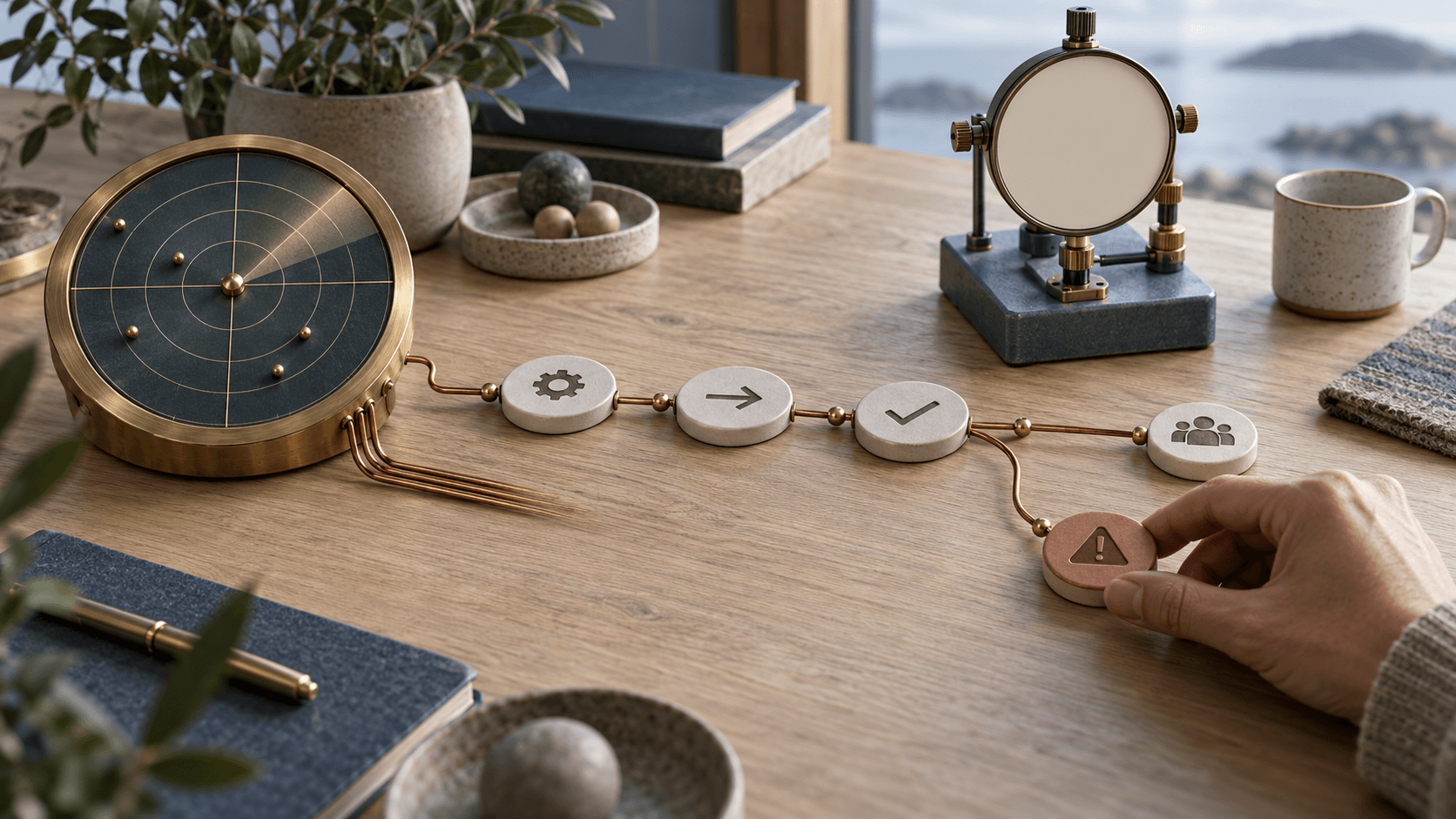
About the episode: This is an AI-generated masterclass, produced with NotebookLM from Hammer's deep daily research into AI providers' updates and features. The article uses that research and a source-scoped NotebookLM synthesis, without audio transcription. The clinic illustration is a conceptual image.
The Forge newsletter
Get new articles in your inbox
Pick the topics you care about. No noise, at most one email a week.
We follow GDPR. Unsubscribe anytime.