Your AI voice reveals the brand before it solves the problem

An AI voice can give the correct answer and still make the customer want to end the call.
It is easy to buy voice as a technical feature: pick a model, pick a voice, write instructions. The customer hears something else. Pace signals whether you are calm or rushed. Interruptions reveal whether you listen. The way the voice recovers from a misunderstanding says more about your service than a flawless welcome line.
My claim is simple: the AI voice becomes the brand before it solves the problem. It should not be chosen in a vendor demo. It should be auditioned blind in the customer moments where your brand can actually gain or lose trust.
Choosing a voice is now a casting decision
On July 6, xAI released 21 new multilingual voices and described them as cast for roles in support, characters, commentary, advertising, and education. That is a useful shift. The question is no longer only whether synthetic speech sounds human. It is what kind of person the voice resembles while representing the organization.
xAI says the voices support more than 25 languages and provides controls for elements such as speed, pauses, emphasis, and pronunciation. That creates more room to shape the experience, but also more ways to make the wrong choice. A warm voice may sound considerate in a calm booking call and patronizing when the customer is already frustrated. An energetic voice may fit a product demonstration and feel exhausting in a dispute about an incorrect invoice.
Source: 21 New Flagship Grok Voices.
The commercial consequence is larger than audio quality. The voice sets expectations for the service that follows. A confident voice implies reliable answers. A personal voice implies that the customer will be remembered. A fast voice implies that the issue will move quickly too.
The brand is loudest when the conversation goes wrong
Almost any voice can sound good while reading a polished sentence without interruption. Customer experience is often decided elsewhere:
- The customer starts speaking before the voice has finished.
- A Swedish name or place name is pronounced incorrectly.
- The customer switches from Swedish to English mid-sentence.
- The system does not know the answer and must admit it without sounding evasive.
- A person takes over and the customer should not have to start again.
This is where voice becomes behavior. xAI's current Voice Agent documentation makes the mechanics tangible: silence duration affects when a turn is considered complete, prefix padding can capture the start of a word, language hints can guide transcription and replacement rules can correct pronunciation without changing the transcript. Playback speed is adjustable as well. These are not merely engineering settings. They influence whether a customer feels interrupted, understood or dismissed.
Source: Speech to Speech – xAI Voice Agent.
OpenAI describes the same underlying problem from another angle. Its Realtime API can use WebRTC, WebSocket or SIP depending on whether the voice runs in an app, a server-side media stream or telephony. The transport is invisible to a caller; delay, interruption and turn-taking are not. A technically correct integration can still sound wrong for the brand.
Source: Realtime and audio – OpenAI API.
Run a blind audition, not a popularity poll
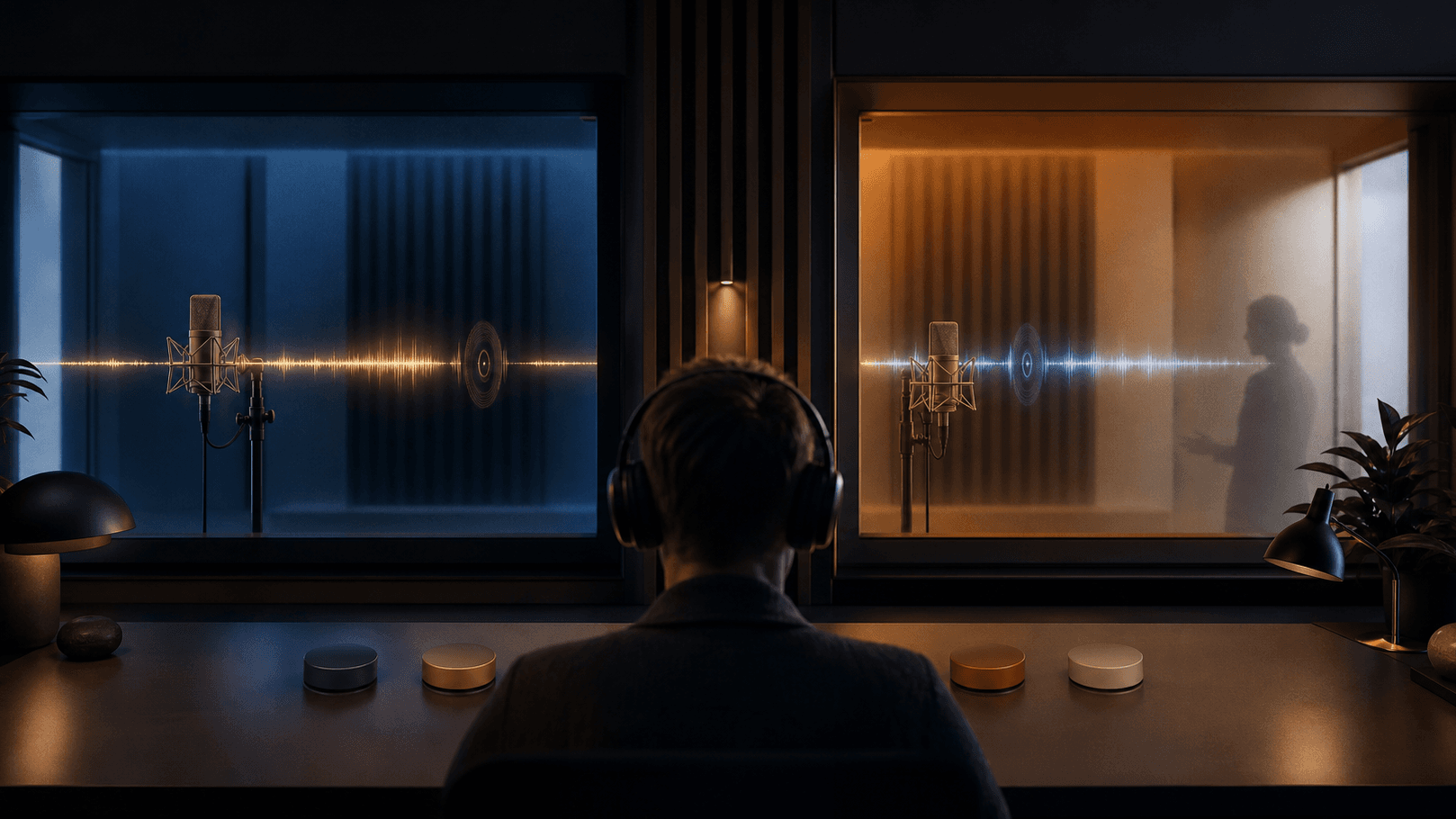
A blind audition asks people to hear the same scene with several voice configurations without knowing the vendor, model, or voice name. The goal is not to crown the voice most people call “pleasant.” It is to find the voice that carries the right behavior in a real customer moment.
Choose three short scenes from your work. They should be common enough to matter and different enough to expose a mismatch. For example:
Scene 1: first contact
A customer wants to move an appointment. The voice must be clear and decisive without sounding mechanical.
Scene 2: friction
The customer interrupts and says that the name or issue is wrong. The voice must stop, acknowledge the correction and continue without adding a long explanation.
Scene 3: the handoff
The system cannot resolve the question. The voice summarizes what it understood and transfers the customer to a person without promising a wait time it cannot guarantee.
Record every scene in Swedish and English. Keep the message, turn order and failure point as consistent as possible. Change only the voice configuration. If a provider does not support one scene or language, that is a result—not a gap to fill with assumptions.
Let people listen without product names and rate five qualities from one to five:
- Trust: Would you stay in the conversation?
- Brand fit: Does this sound like us at our best?
- Interruption: Does the customer get room to finish?
- Recovery: Is a misunderstanding corrected without adding irritation?
- Handoff: Does the move to a person feel natural and clear?
Then ask for one sentence of free comment: “What made you choose that rating?” This is usually where the brand issue becomes visible. “Friendly” can mean reassuring to one person and artificial to another. “Professional” can mean clear or cold. The score reveals the pattern; the comment explains it.
Swedish and English are two auditions, not one dubbed test
A voice that works in English does not automatically carry the same social tone in Swedish. Pace can change. Emphasis can land in the wrong place. A company name may sound natural in one language and foreign in another. Turn-taking also feels different as sentence length and rhythm change.
On July 23, Anthropic announced that Claude Voice could use Opus, Sonnet and Haiku, connected tools and an expanded language list in the Claude apps. Swedish was not included in the published list. That does not prove Claude is “worse” as a voice product; it means the product's current language support does not fit a Swedish customer test. Anthropic is also describing an app feature, while xAI and OpenAI have developer APIs in this comparison. They should not be ranked as though their surfaces and contracts were identical.
Source: Think through hard problems in voice mode.
Do not run the English scene first and translate the winner. Treat both languages as separate customer encounters. If the same voice does not win in both, you may choose different profiles by language. Another option is the voice that ranks second in each language but remains the most consistent expression of the brand.
Listen for the cost of the wrong personality
A poor voice choice may not show up in conversion rate during the first week. It can create smaller, expensive effects instead:
- Customers interrupt more often because the voice talks too long.
- Staff inherit calls where the customer is already annoyed.
- A school or care conversation sounds too much like a sales pitch.
- A premium service sounds like a bargain queue, or the reverse.
- The team compensates for a poor voice match with increasingly long instructions.
That final symptom is especially revealing. If the prompt needs several versions of “warm but not too warm, quick but not rushed, personal but not familiar,” the base voice may be wrong. Instructions can guide behavior, but they cannot always remake the social signal a listener hears.
A stronger business measure than “sounds human” is how often the voice helps the scene reach its intended conclusion. Was the appointment changed? Does the customer understand what happens next? Does the human colleague receive a neutral starting point after the transfer? Those outcomes matter more than applause for an impressive demo.
Record the version—and audition it again when it changes
Voice products move quickly. An alias can point to a new underlying model, an older realtime model can receive a shutdown date and a provider can retrain existing voices. OpenAI, for example, has announced that several legacy audio and realtime models will be removed on January 20, 2027, with newer replacements recommended. xAI also describes retraining its original voices for more natural pacing, phrasing and emphasis.
Source: Deprecations – OpenAI API.
Record the exact model, version, voice, language, instruction, and three audition scenes. You can then rerun the same test after a model change and hear whether the brand still feels recognizable. Without that evidence, every upgrade becomes a new debate about taste.
Choose the voice that survives your hardest moment
The best AI voice is not the one that sounds most impressive alone in a headphone demo. It is the one that resembles the right colleague when the customer interrupts, hesitates or needs a handoff.
Run the audition with five to eight people: some who know the brand well and some who encounter it less often. Hide the vendor names. Compare Swedish and English separately. Do not look only at the average; find the scene where a voice collapses. A beautiful first impression counts for little if recovery from an error feels dismissive.
If you then want to build a voice agent around the winning experience, Tool Forge can connect telephony, source material and the human handoff. But do not start with the integration. Start by listening to the same uncomfortable customer moments until you can hear which voice actually sounds like you.
FAQ
How does an AI voice affect a brand?
Customers hear pace, tone, confidence and interruption behavior before the issue is resolved. The voice therefore shapes trust and expectations like any other part of the customer experience.
How do you run a blind audition for AI voices?
Play the same realistic customer scenes without revealing the vendor, model or voice name. Ask listeners to rate trust, brand fit, interruption handling, recovery from misunderstandings and the handoff to a person.
Can the same AI voice be used in Swedish and English?
Sometimes, but test each language separately. Pace, emphasis, pronunciation and turn-taking can feel different, and provider language support varies. Separate voice profiles may create a more consistent brand.
The Forge newsletter
Get new articles in your inbox
Pick the topics you care about. No noise, at most one email a week.
We follow GDPR. Unsubscribe anytime.