Claude Sonnet 5.5 usage guide: effort, costs and everyday work


Start with Sonnet 5.5 at medium effort for clearly defined work. Use high for deeper investigation, and compare Opus when a task needs more reasoning. This is a useful starting point for bug fixes, document preparation, recurring reports and business automation.
Sonnet 5.5 launched on September 28, 2026, at $2 per million input tokens and $10 per million output tokens. Its strongest cost-saving opportunity is repeatable work with clear inputs, a specific deliverable and a reliable way to check the result.
Choose the effort that fits the job
Effort controls how much thinking and tool work Claude puts into a response. Higher settings generally spend more tokens and take longer.
- Low: classification, straightforward extraction, short rewrites and narrowly scoped subagents. Make the completion check explicit, especially for code.
- Medium: well-specified bug fixes, documents built from supplied material and multistep tool workflows. This is the launch default in Claude Code and Claude apps.
- High: harder debugging, analysis and tasks that need more investigation. This is the Claude API default. It is also worth testing for recurring business automation.
- Xhigh: demanding work where your tests show a useful gain over high. Include Opus medium and high in the comparison.
- Max: tasks where the extra accepted results justify the additional time and spending. Define the scope and stopping point carefully.
Anthropic recalibrated effort for Sonnet 5.5, so run a fresh comparison using your own tasks when upgrading from Sonnet 5. If medium stops early or skips checks, try high. If the model has investigated thoroughly and still makes the wrong judgment, compare a more capable model.
Sources: Anthropic's effort guidance and Sonnet 5.5 prompting guide.
How much can Sonnet 5.5 save?
At standard API rates, Sonnet's input and output tokens cost 50% less than Opus 5.5's and 80% less than Fable 5.1's. For identical usage of one million uncached input tokens and 200,000 output tokens, including billed thinking:
- Sonnet 5.5: $4.
- Opus 5.5: $8. Switching saves $4.
- Fable 5.1: $20. Switching saves $16.
Actual task savings depend on token consumption, effort, retries and review time. These examples cover standard API token charges; tools, provider premiums and taxes are additional. Claude Pro and Max have separate subscription billing.
Caching changes the comparison. Cache reads cost $0.20 per million tokens for both Sonnet and Opus, and $0.25 for Fable. The more your workload relies on cached input, the smaller the overall price gap becomes. Cache writes have their own rates; Sonnet charges $2.50 per million tokens for a five-minute cache. Batch processing offers a separate 50% discount on input and output.
Compared with Sonnet 5, Anthropic reports up to 30% lower cost per task through reduced token use at the same standard token prices. It also reports 30%+ faster output generation. Measure the effect on your complete workflow, including tools and review.
Sources: official pricing for Sonnet, Opus and Fable; Sonnet 5.5 launch.
Where Opus becomes worth comparing
Artificial Analysis's Intelligence Index v4.3.2 shows how quickly Sonnet's task cost rises with effort. These are rounded index points / weighted average USD per index task:
- Sonnet 5.5: low 36 / $0.41; medium 41 / $0.59; high 47 / $1.08; xhigh 52 / $2.74; max 56 / $7.60.
- Opus 5.5: low 42 / $0.55; medium 51 / $1.34; high 54 / $1.82; xhigh 56 / $3.46; max 58 / $5.98.
- Fable 5.1: low 47 / $2.37; medium 49 / $2.98; high 51 / $3.91; xhigh 53 / $5.98; max 53 / $7.63.
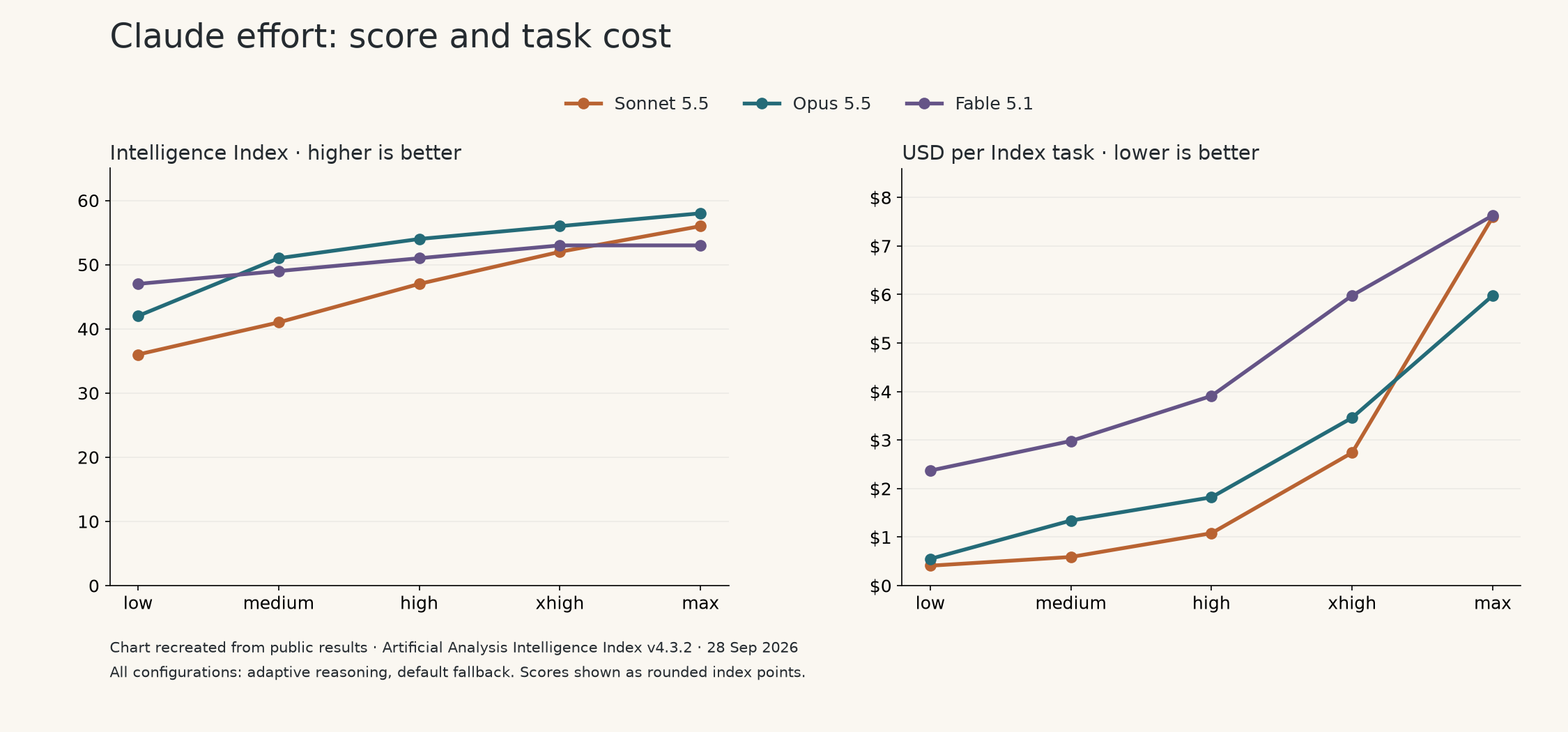
Chart recreated from Artificial Analysis's Sonnet, Opus and Fable results, checked September 28, 2026. Adaptive reasoning with default fallback.
The useful buying comparisons are:
- Opus low against Sonnet medium: 42 versus 41 points, at $0.55 versus $0.59. Include both in a trial of routine work.
- Opus high against Sonnet xhigh: 54 versus 52 points, at $1.82 versus $2.74. Opus costs about 34% less on this benchmark mix.
- Opus xhigh against Sonnet max: both display 56 points, at $3.46 versus $7.60. Opus costs about 54% less at that rounded score.
These results describe a mainly English-language benchmark mix. Artificial Analysis estimates a 95% confidence interval of less than ±1% for the composite; individual evaluations can have wider intervals. Treat close scores as candidates for testing on your workload. Default fallback means some requests may be answered by another model.
Source: Artificial Analysis methodology.
A useful business-automation result
On AutomationBench-AA, Sonnet high scores 59.1% at approximately $0.344 per task, versus 54.7% at $1.643 for Fable medium: around 79% lower task cost. Opus medium scores 61.2% at $0.638. This makes Sonnet high a promising option to test for recurring business workflows.
The metric measures the share of objectives completed across simulated SaaS tasks, with zero credit for tasks that violate guardrails. The result supports this specific automation use case; performance varies across other evaluations.
Sources: Artificial Analysis model data and AutomationBench-AA. Task costs calculated from published weighted contributions and evaluation weights.
Give Sonnet a clear finish line
Sonnet is well suited to work such as preparing a monthly report from a fixed set of files, drafting support replies from approved material or fixing a bug with reproducible tests. Give it the source material, the deliverable, the scope and the check that establishes completion.
For a coding task:
Fix the reported invoice-export bug. Reproduce the failure, keep changes within the export path, and run the relevant tests. Report their actual results. Stop once the requested fix passes its checks. Ask before destructive changes or actions in external systems.
For reports, specify the template and require reconciled totals. For research, request current sources and dates. Give it crop, zoom or code tools for dense charts. Anthropic found that these tools at high effort improved chart reading beyond max effort alone.
At xhigh and max, explicit stopping conditions help control extra review rounds and related changes. Anthropic's FrontierCode results illustrate the trade-off: Sonnet scored 52.1% at xhigh and 46.2% at max, with examined max failures involving timeouts and out-of-scope work.
Sources: Sonnet prompting guide and launch benchmark notes.
Check these details when switching an API workflow
Use claude-sonnet-5-5 and set output_config.effort explicitly. The model supports a one-million-token context window and up to 128,000 output tokens.
- Thinking and tools: use adaptive thinking for reasoning tasks. The
between_toolsmode removes up-front thinking at low, medium and high. Existing integrations using disabled thinking or forced tool choice need migration changes. - JSON: for totals, rules and ranking, use adaptive thinking and ask Claude to think through the problem before answering. Check the result and
stop_reason; treatmax_tokensas a failed attempt, even with valid JSON, and retry within a bounded budget. - Budgets and caching: allow room for thinking within
max_tokensand set a separate budget for the complete workflow. Changing top-level effort resets the prompt cache; supported per-message effort changes preserve it with adaptive thinking. - History and progress: review the new thinking-block compatibility and streaming behavior when moving existing conversations or displaying tool progress.
- Data and fallback: confirm your retention arrangement and log the model that actually served each response. Sonnet offers zero-data-retention arrangements; Fable 5.1 carries 30-day retention unless Anthropic expressly authorizes an alternative.
Sources: Sonnet model overview, prompting guide and Fable retention requirements.
Start with a small batch of real work
Run the same representative tasks through Sonnet medium, Sonnet high and the nearest Opus alternatives. Keep tools, context and acceptance criteria consistent. Track total cost, turnaround time, retries and human correction time.
Choose the configuration with the lowest total cost per accepted result. For Sonnet 5.5, the strongest starting point is clearly scoped everyday work at medium or high effort.
Based on public benchmark results and official documentation checked September 28, 2026.
FAQ
Which Sonnet 5.5 effort setting should I start with?
Start with medium for well-specified coding and multistep tool workflows, high for harder investigation, and low for simple, easily checked work. Claude Code and apps default to medium at launch; the API defaults to high.
How much can I save with Sonnet 5.5?
Standard input/output rates are $2/$10 per million tokens: 50% lower than Opus 5.5 and 80% lower than Fable 5.1 at identical usage. Actual savings depend on effort, caching, retries and review time. Cache reads cost $0.20 for Sonnet and Opus, and $0.25 for Fable.
When should I compare Sonnet with Opus?
Include Opus when considering Sonnet xhigh or max, or when your task needs stronger judgment. In Artificial Analysis’s published results, Opus high scores 54 at $1.82 per index task, versus Sonnet xhigh’s 52 at $2.74. Test both on your own acceptance criteria.
The Forge newsletter
Get new articles in your inbox
Pick the topics you care about. No noise, at most one email a week.
We follow GDPR. Unsubscribe anytime.