When the AI Agent Moves from Chat to Coworker


The most important part of this podcast is not another model release. It is the shift from AI that answers questions to AI that actually performs work: across tools, across time, and inside explicit security boundaries. Listen to the episode to hear how Anthropic, Google, and OpenAI are building three different parts of the same new work stack — and contact Hammer Automation if you want help forging the AI skills your organization needs.
🎧 Why this episode is worth your time
This episode captures a clear transition: the major AI vendors are no longer only competing on smarter models. They are building the environments around the models — tools, memory, permissions, sandboxes, scheduling, and observability.
That is where the business value starts becoming concrete. Not when another chatbot writes a cleaner answer, but when an agent can:
- Run a workflow in the background
- Retrieve the right context from the right system
- Perform tasks inside a secure environment
- Wait, continue, and report back when the job is done
The episode is worth listening to if you want to understand why the next AI step is less about “prompts” and more about how work is designed around autonomous digital coworkers.
🧱 The new agent stack is taking shape
A central point in the episode is that raw intelligence is no longer the only bottleneck. Vendors are instead building what makes that intelligence useful in daily work: hands, desks, memory, and permissions.
Three strategies stand out:
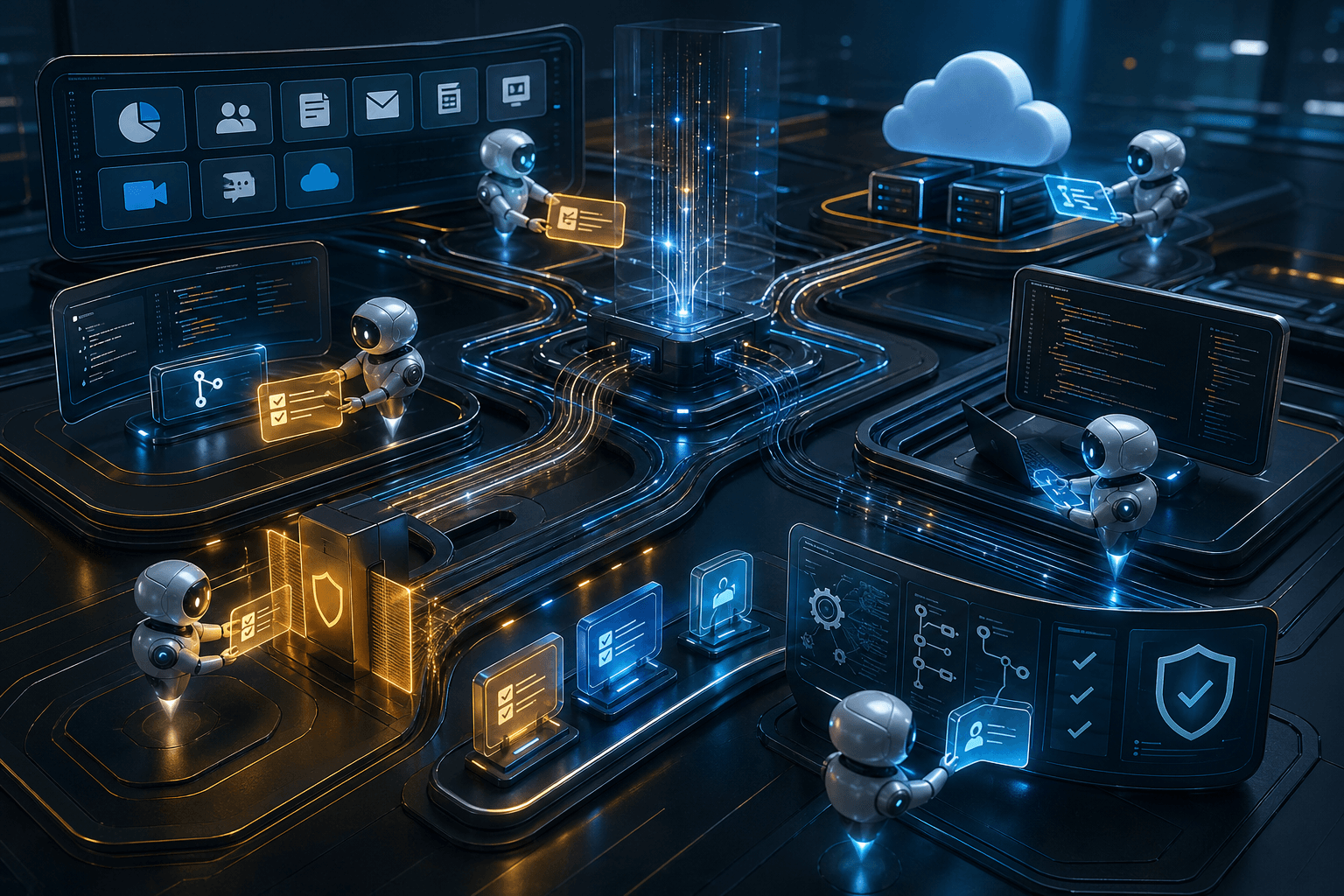
- Anthropic is focusing on the local developer and desktop environment. The AI agent should be able to work where the user actually has files, terminals, and tools.
- Google is focusing on Workspace: documents, Drive, Sheets, and the permissions companies already use.
- OpenAI is focusing on the backend layer: persistent agent threads, remote environments, session state, and deeper observability.
Together, they point toward the same shift: AI is moving from interaction to outcome.
🖥️ Anthropic: the agent on your machine
Anthropic’s part of the story is about making AI useful in local work environments. The episode discusses Claude Code features that can run work in parallel across multiple Git worktrees, plus loop-like background execution that lets the agent check things over time.
That may sound technical, but the consequence is simple: AI can begin handling more repetitive development work without the user sitting next to it the entire time.
Security becomes the decisive issue. When an agent gets access to files, code, and local tools, it also needs clear constraints. The episode highlights risks such as MCP package typosquatting and the need for granular permission modes, human confirmation, and isolated virtual environments for executable code.
The lesson for every company is straightforward: agentic AI needs both productivity and guardrails. One without the other will not hold.
☁️ Google: the workspace becomes an active knowledge engine
Google is taking a different route. Instead of starting on the desktop, it is embedding Gemini more deeply into Workspace.
That means Drive is no longer just passive storage. It can become an active research layer where teams ask questions across historical knowledge, documents, and projects — governed by the same permissions and DLP rules already in place.
In Sheets, the shift becomes even clearer. The episode describes how Gemini can turn unstructured text into working spreadsheets with structure, formulas, and interface elements. The big value is speed. The big risk is reliability.
That is why human verification remains central. AI can create the first draft, but people still need to review the logic before it affects real decisions.
⚙️ OpenAI: the agent as a long-running backend process
The OpenAI part of the episode is more about the infrastructure behind autonomous systems. The focus is on models acting as a control plane for tools, long context, remote threads, and environments that continue even when the user switches machines.
That is a major step from “help me with this code snippet” to “run this process until it reaches a verifiable result.”
But long-running agents also require visibility. If an agent works for hours or days, teams need to understand:
- What it did
- Why it got stuck
- Which tools it used
- How much it cost
- Which decisions need review
That is why observability, session state, and cost control become as important as the model itself.
🔨 What this means for companies
The practical message is that AI work is moving from manual chat to designed systems. The future advantage is not just having access to the tools, but knowing how to connect them safely and meaningfully.
For many organizations, the next step is to identify workflows where agentic AI can create measurable value:
- Recurring reports
- Research and summaries
- Document and knowledge management
- Simpler development and testing workflows
- Internal support processes
- Data refinement and decision support
The pace can feel overwhelming. But you do not need to start with everything. You need to start with the right workflow, the right guardrails, and the right skill-building process.
If you want to move from reading about AI agents to actually building useful workflows in your organization, listen to the podcast, collect the questions it raises — and contact us at Hammer Automation. We help teams forge the knowledge, processes, and automations required to use AI safely and practically.
Thoughts on how this affects the future
The next big question is not only how humans talk to AI. It is how AI agents talk to each other.
When one company uses several agent environments at the same time — a local desktop agent, a Workspace agent, and a backend agent — interoperability, secure data handoff, and responsibility boundaries become critical. Much of the next wave of AI work will be decided there.
The companies that start learning now will have an advantage. Not by chasing every new release, but by building the ability to understand, evaluate, and forge AI into working everyday processes.
The Forge newsletter
Get new articles in your inbox
Pick the topics you care about. No noise, at most one email a week.
We follow GDPR. Unsubscribe anytime.