Require a source receipt when AI reads company data

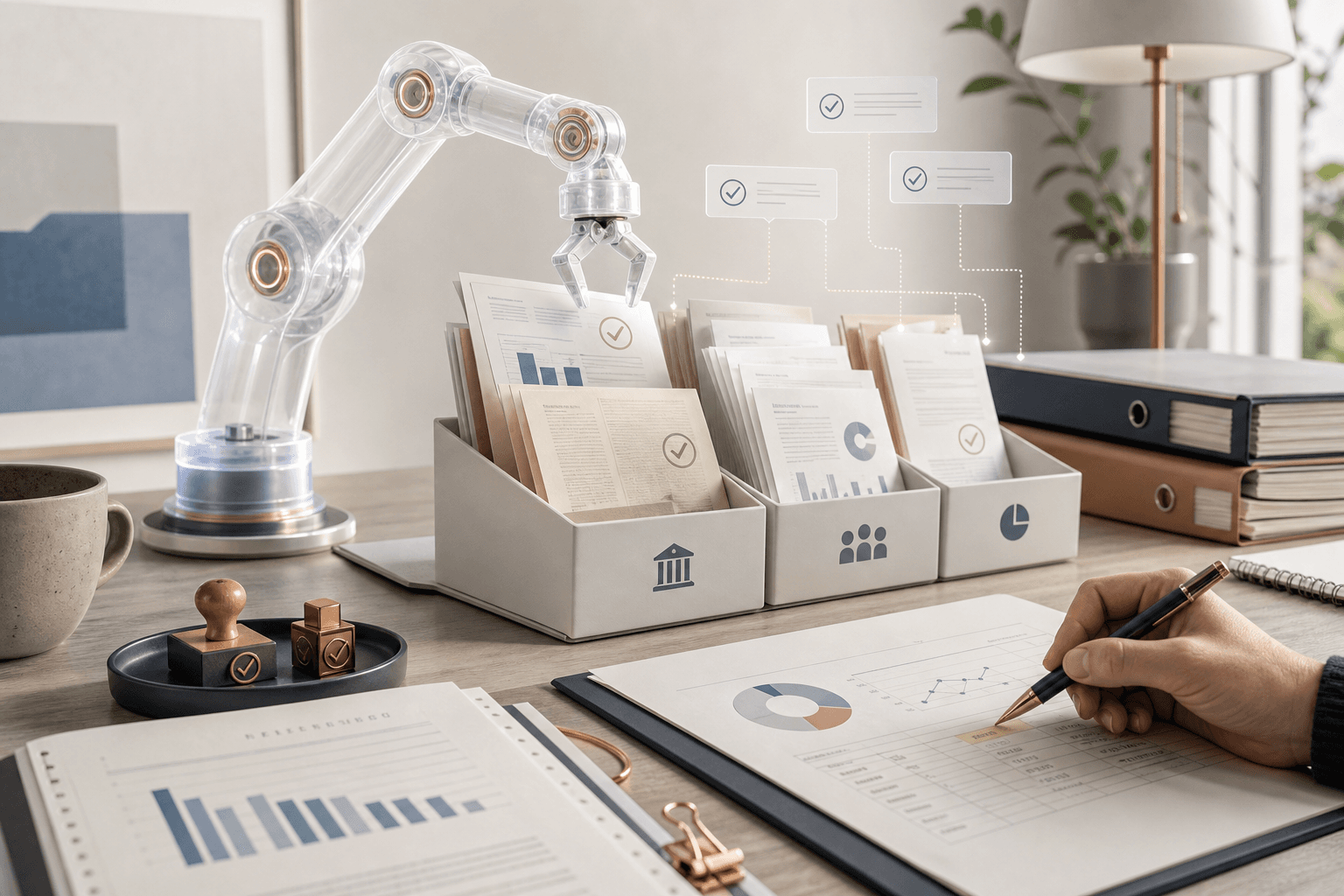
When AI starts helping with company research, the temptation is obvious: paste in the company name, ask for a summary, copy the answer into a report. It saves time. It can also move a wrong number, an old job title, or a loose interpretation straight into decision material.
That is why the workflow needs a source receipt. By that I mean a simple rule: every claim that affects a decision must point back to a source, a date, and a human who approved its use.
Why this matters now
Anthropic wrote in its Claude Platform release notes on May 18, 2026, that Claude API web search now returns richer SEC filing data. SEC filings are company submissions to the U.S. Securities and Exchange Commission, such as annual reports, quarterly reports, and other documents from public companies. For financial research, due diligence, and earnings reviews, the signal is clear: AI tools are moving closer to primary sources.
Source: Claude Platform release notes
Claude's documentation also describes web search as an API tool where Claude can search current web content and answer with citations. The latest version, web_search_20260209, can use dynamic filtering when code execution is enabled. That means irrelevant search results can be filtered out before they fill the model context.
Source: Claude web search tool documentation
That is useful. But it does not make the answer board-ready. A citation is not the same thing as a checked conclusion.
The line between research support and advice
For Hammer readers building practical AI workflows, the boundary matters. AI can help find a document, extract a number, compare two periods, and draft the first version of a report. It should not pretend to be an auditor, lawyer, or financial adviser.
A healthy split of responsibility looks like this:
- AI gathers: find reports, extract quotes, suggest summaries, and list uncertainties.
- The system tracks: source, link, publication date, document type, period, and the prompt used.
- The human approves: numbers, conclusions, recommendations, and wording that affect a decision.
This sounds bureaucratic until something is wrong. Then the source receipt is the difference between "the AI said so" and "we know exactly where this came from".
More tools are moving in the same direction
Perplexity has documented people_search in its Agent API. The tool is built for professional people and organization research: roles, companies, background, and leadership teams. The documentation is clear that it fits people and organization queries, not general web search.
Source: Perplexity Agent API People Search
OpenAI and Dell, meanwhile, wrote about bringing Codex closer to enterprise data in hybrid and on-prem environments. OpenAI explicitly names use cases beyond code: reports, product feedback, lead qualification, follow-ups, and coordination across business systems.
Source: OpenAI and Dell Technologies partnership
Put the signals together and the picture is practical: AI is moving out of the chat window and into research, reporting, and internal systems. So it is not enough to ask, "was the answer good?" The next question is: can we show how the answer was made?
Build the source receipt before the workflow becomes automatic
If you want AI to help with company data, start small. Pick a recurring deliverable where research takes time, but a human still reviews the decision. A supplier overview, competitor watch, or board memo is usually better than starting with a high-risk workflow.
Then write down the receipt the workflow must produce:
- Source type: annual report, quarterly report, press release, regulatory filing, web page, or internal file.
- Source fields: URL, document name, publication date, period, retrieval time, and page reference if relevant.
- Claim fields: exact number or wording, the AI's interpretation, and what remains uncertain.
- Review fields: responsible person, approved or stopped, date, and comment.
- Cost fields: search tool, number of searches or runs, and who owns the cost.
- Stop rule: what the AI should do when the source is missing, dates conflict, or numbers do not match.
The point is not to create a giant governance program. The point is that nobody should have to guess where a number came from three weeks later.
A simple workflow to start with
A first version can look like this:
- Use AI to find and summarize one specific company document.
- Require the answer to include source link, document type, date, and period.
- Ask the AI to mark each number as "extracted", "calculated", or "interpreted".
- Put everything into a simple review sheet.
- Require a named person to approve it before the text is used in customer material, board papers, or decisions.
Only automate more once this works manually. Otherwise, you are just automating uncertainty.
When Hammer can help
This is a Tool Forge problem: not "which AI model is smartest?", but "how do we make a workflow we can trust?".
Hammer can help design a source-led research workflow for one concrete report type: which sources are allowed, which fields must be saved, where the human review happens, and when the AI should stop. No pretend guarantees. Just a more controlled way to use AI when numbers and sources matter.
The Forge newsletter
Get new articles in your inbox
Pick the topics you care about. No noise, at most one email a week.
We follow GDPR. Unsubscribe anytime.