The chatbox is dead: AI agents are taking over the workspace

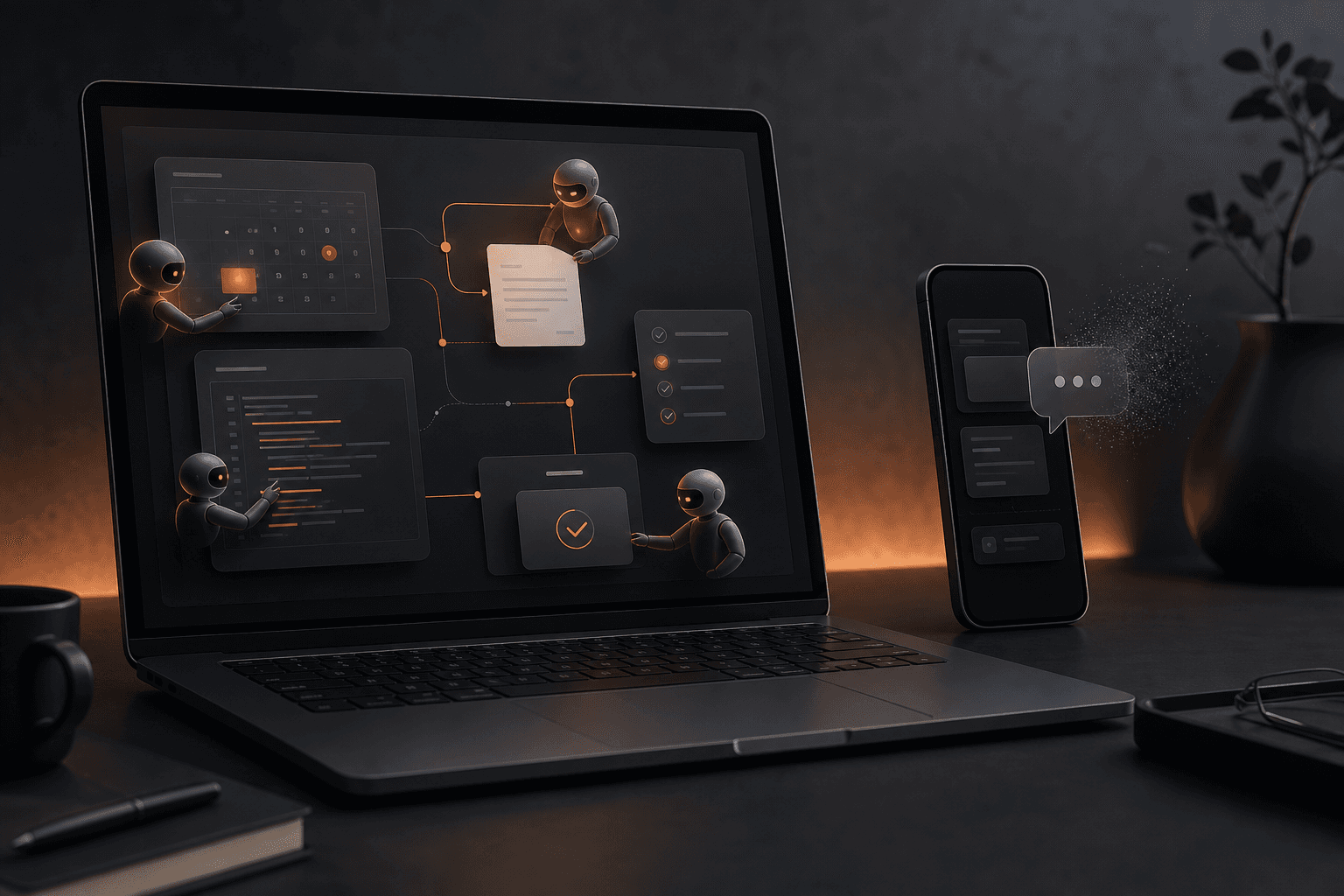
A technology shift becomes visible when it stops being abstract. You are no longer talking to an empty box. You are trying to book parking, fill in a broken form, or understand a long contract, and suddenly the AI wants to do something on the screen.
That is the core of this podcast episode: the chatbox is dying as the main metaphor. It is not being replaced by yet another smarter text field, but by agents that can read context, use tools, wait for permission, and keep working while you do something else.
From answers to work
A chatbot answers. An agent tries to finish a goal.
Agentic AI means the model does not only produce text. It plans steps, uses tools, and comes back when it needs human judgment. That sounds small until you put it into an everyday situation: a broken municipal parking page, a handwritten grocery list in a text message, or a pile of customer cases that must be checked against your own policy.
The episode starts there. Not with science fiction, but with the irritation of software that still forces people to click through every tiny box. When AI can see the screen, understand what you are trying to do, and suggest the next step, the role of the whole interface changes.
The computer becomes less like a power drill and more like a junior colleague. It does not do everything alone. But it also does not sit passively waiting for the next perfect prompt.
The screen becomes a workspace
One of the strongest threads in the episode is screen context: AI interpreting what you are already looking at.
It might be a photo of a handwritten grocery list, a date in an email, or a messy form. The point is not just OCR, meaning text extraction from an image. The point is that the system tries to understand intent: "this looks like a list that should become a shopping cart" or "this date belongs in the calendar".
That is a bigger shift than another better search box. If pixels can become actionable objects, the user no longer has to translate everything into commands. The AI can meet the work where it already happens.
The company question: access without chaos
For companies, the question is not "can AI write a reply?" It already can. The question is whether it can write the right reply with the right data, without leaking anything or inventing policies.
The episode brings up NotebookLM, RAG, and MCP as parts of the same movement.
RAG, retrieval augmented generation, means the AI retrieves information from a controlled knowledge source before it writes. It is the difference between a general model guessing your returns policy and an assistant actually reading your own rules.
MCP, Model Context Protocol, is best understood as a secure bridge between the AI and a specific system, such as documents, contracts, CRM, inventory data, or support tickets. The acronym is not the point. What matters is narrow, traceable access instead of someone pasting sensitive information into a public chat.
This is where many organizations will feel the biggest difference. AI does not become useful because it can talk more convincingly. It becomes useful when it can work close to your real systems without losing control.
Agentic work needs brakes
The episode also talks about Claude Code, Codex, and ways of working where AI no longer just responds turn by turn. You give it a goal, the agent breaks the work down, runs steps in the background, and stops when it needs approval.
That is practical. It is also a new kind of responsibility.
When an agent can delete files, change databases, email customers, or create decision material, the organization must decide where it can act alone and where a human has to press the brake. Permissions, logs, sandboxes, and clear stop points are not bureaucracy. They are what make agentic work usable without turning it into a lottery.
A useful rule from the episode's theme: let AI do the preparation, but make humans approve actions that affect money, customers, law, security, or reputation.
Security becomes part of the product
The most grounded part of the episode is about security. Not as a separate checklist afterward, but as the material the product is built from.
Temporary sandboxes, isolated runtimes, and short-lived workspaces let an agent analyze files or run code without leaving data behind for the next task. That kind of architecture is what AI needs if it is going to work near a company's real information.
The episode also points to supply chain risks: fake packages, malicious code, and dependencies that look legitimate. It is easy to talk about AI like magic. Underneath it all, there is still ordinary software, ordinary package registries, and ordinary security mistakes.
Four ways to win the agent era
The episode sketches a clear map of where the market is moving.
- Google is trying to make AI disappear into the everyday flow: the phone, the screen, the documents, and the workspace you already use.
- Anthropic leans toward companies and regulated environments: controlled access, connections to existing tools, and human approvals.
- OpenAI is building much of the execution infrastructure: secure sandboxes, remote control of agents, and ways to keep people close to decisions without trapping them at the desk.
- Perplexity, Manus, xAI, and others are chasing more specific workflows: research, finished presentations, coding environments, and competitive analysis that go from question to delivery.
The interesting part is that all of them are moving away from the same old chatbox. They want to own the workspace, not just the conversation.
What you can do this week
Pick one workflow where people currently copy information between systems. Not the biggest or most political one. Pick something mildly annoying.
Then test this prompt internally, without sensitive data:
You are a process analyst. Look at the workflow below and suggest where an AI agent could help.

Describe:
1. What information the agent needs to see.
2. Which tools or systems it would need to use.
3. Which steps it can do alone.
4. Which steps a human must approve.
5. Which logs, permissions, and stop points are required.

Workflow:
[describe a real but non-sensitive example]
This is a good first step for Tool Forge/Verktygssmide: not "build a huge AI agent", but map where the agent may look, where it may act, and where it must stop.
The chatbox is not literally gone. It will remain a convenient interface. But it is no longer the endpoint. It is the door handle.
What comes next is AI that can touch the work itself.
The Forge newsletter
Get new articles in your inbox
Pick the topics you care about. No noise, at most one email a week.
We follow GDPR. Unsubscribe anytime.