Trapped: Founders and the Ambient AI Shift — a podcast you can't miss


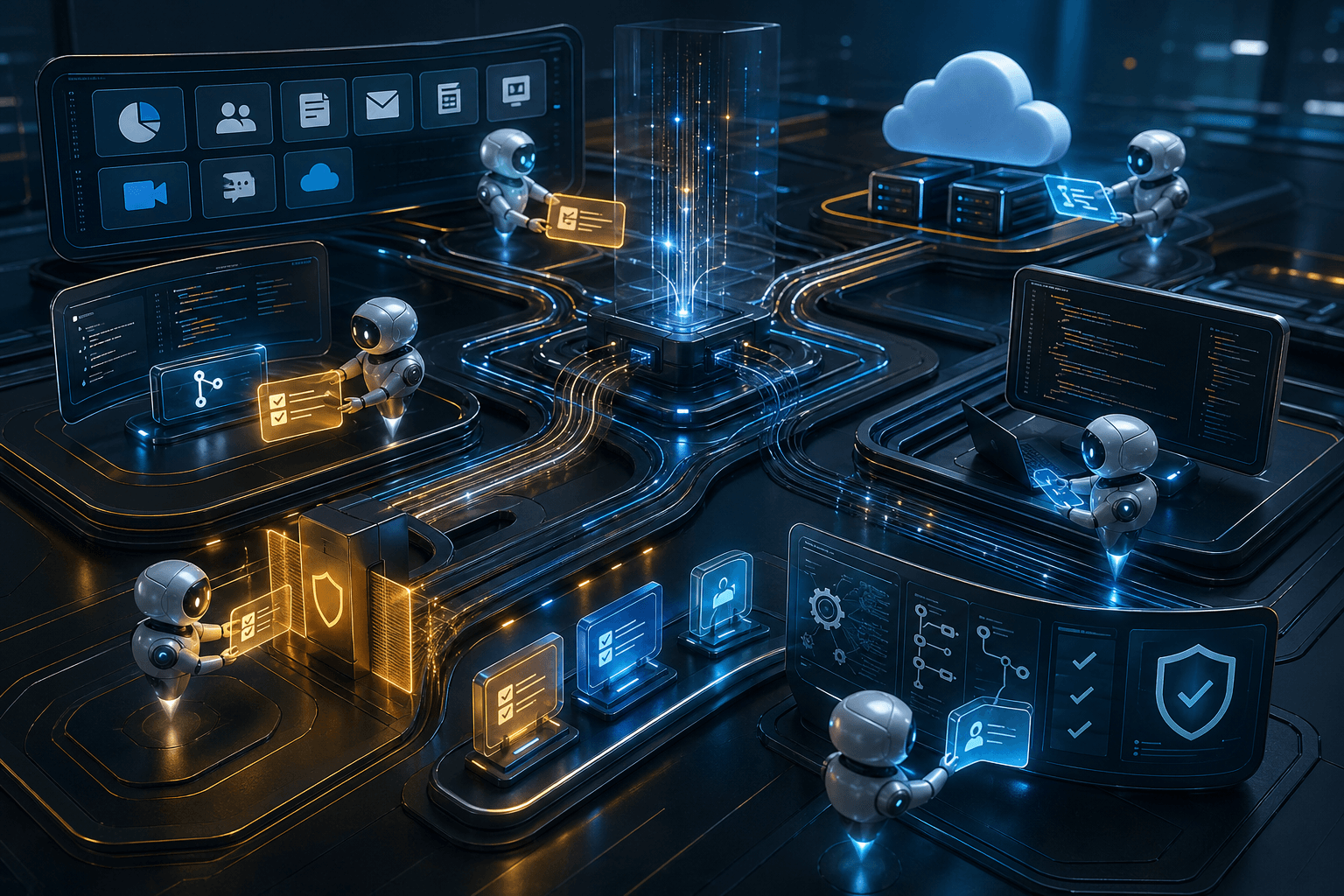
A founder sits physically trapped in Beijing. Meanwhile, his AI agent reads our internal Slack channels. The border between software and national security hasn't just blurred — it has collapsed. In this 41-minute podcast, the team breaks down the violent week that just shook the tech world: geopolitical drama, massive model updates, and the ambient AI shift that changes your working life forever.
Why this podcast is different from your average news brief
Most podcast episodes you hear are polished marketing posts. This is not that. Here you get raw intelligence — GitHub logs, silent model deprecations, technical changelogs and the uncomfortable decisions big tech companies make. The team behind the show has combed through the April 20 2026 research briefs and woven them into a story that affects you directly — whether you build systems, lead engineering teams, or just wonder where the puck is going.
The point isn't information. The point is insight. And after this episode, you won't look at your AI coworker the same way again.
🌍 Teaser 1: The driver is stuck — but his AI keeps rolling
The podcast opens with the dizzying parallel: Manus AI co-founders Xiaohong and Ji Yikao are physically barred from leaving China after meeting with the National Development and Reform Commission. Meanwhile, their AI agent is rolling out a Slack integration at a major Western enterprise. The agent sits in private internal channels and operates as an autonomous team member.
What it's about: Singapore-washing is dead. The strategy where Chinese founders built technology in China, relocated their company to Singapore, then sold to Western tech giants — that practice has now been invalidated by Beijing. Manus executed it right before Meta's acquisition plans. Now the founders are stuck. But their product continues acting inside our flows.
Why this matters to you: If next month you're considering integrating an AI agent into your organization's Slack, Teams or internal tools — whose laws apply? What happens to your data if the vendor's home country suddenly demands IP carve-out or backdoor access? The podcast walks through this exact scenario. It's no longer a theoretical question.
🔧 Teaser 2: Anthropic's brutal upgrade — and the price you pay
Anthropic is forcing the market with an aggressive model lifecycle approaching unsentimental. They've taken down Haiku 3 — completely silent, completely abrupt. No warning. Existing systems just fail. Which forces every engineering team with sprawling code to do a forced inventory today.
At the same time, Opus 4.7 is Anthropic's new center of gravity — same price as 4.6, but with API-breaking changes that block easy migration. The team analyzes this sharply: if you want improved long-running performance and higher-resolution vision, you must refactor your integration code. It's not a patch update. It's a rebuild.
The real example: You have an internal system that auto-generates reports every Friday evening. Your cron job still points to Haiku 3. It fails. Silent. No logs. You don't discover it until Monday morning when leadership asks where the report is.
Why you should care: The day you build on someone else's foundational infrastructure, they also own your roadmap. Anthropic shows exactly what hardball looks like.
💰 Teaser 3: Google's $20 strategy and the new developer contract
Google's most striking move is subtle: for $20/month Gemini AI subscribers get increased AI Studio limits and direct access to premium models — Nano, Banana Pro, Gemini Pro — without setting up a corporate account, without linking an API, without managing IAM roles or billing. They blur the line between consumer chat and heavy-duty developer infrastructure.
The team uses an analogy that lands perfectly: previously the building life was binary. Either you used the free hammer in the lobby (hit rate limits instantly) — or you bought a commercial warehouse lease, hired security and wrote long-term contracts (Google Cloud account with credit card, billing, IAM). Now Google is saying: "Pay a flat $20 fee and we'll give you the professional workshop key behind the store."
What it means in practice: The indie builder, startup team or internal tinkerer who previously got stuck at the free wall and then overwhelmed by billing — they can now build proof of concept without going through corporate procurement. Google captures their mindshare long before they formalize API deployment. Strategically brilliant. Practically revolutionary.
⚡ Teaser 4: OpenAI's Workbench updates — the agent that lives in your machine
OpenAI quietly shipped Codex version 0.122.0 — a raft of structural changes that didn't even get a blog post. No Sam Altman on stage. Just pure execution:
- Side conversations (
/side) for quick branching without wiping your main context - Queueable slash commands — stack instructions while the agent works on something else
- Plan Mode handoffs — the agent drafts a full architecture and implements it in a fresh context window
- New deny-reads and discovery policies for the sandbox
The podcast frames this as a product transformation: Codex evolving from a chat assistant to an asynchronous, programmable workbench. The agent works in the background while you eat lunch. When done, it wakes back up with the result.
Real-world scenario: You describe a complex feature. Codex drafts the architectural plan in a separate thread, spins up a Daytona workspace, writes the code, and pushes to a separate branch. You come back from your break and review the result as a "governor" rather than an "operator".
🛡️ Teaser 5: Claude Code 2.013 — the sandbox that thinks
Claude Code 2.013 shipped with three brilliant technical upgrades highlighted in the episode:
67% faster session resume
If you pause a 40MB session (equivalent to a thousand-page novel of pure code) and return — it used to take several minutes to load. Now it happens in about 10 seconds. Why? Anthropic optimized how the system handles "dead fork entries" — failed attempts stored in history that previously forced the AI to review every mistake on every boot.
Analogy: Instead of spending 20 minutes briefing your assistant about where you left off, what failed, and not to try that again — you step out for a shower and come back to a fully organized desk ready for the first question.
AST-based sandbox security
Previously the sandbox used naive string matching to block dangerous commands. A malicious script could bypass the filter by wrapping sudo rm or env rm — because the first word became sudo or env, not rm. Now the sandbox parses the abstract syntax tree — it recognizes that sudo should open and checks the payload inside. "Like a nightclub bouncer that plucks off the fake mustache and sees the banned face underneath."
Network security with domain-specific deny
The system can now fence off specific domains while allowing general outbound traffic. Example: the AI has wildcard permission outbound but api.intern.company.com is permanently locked. This is done via sandbox.network.denydomains.
Practical use: You let an AI agent read Stack Overflow, GitHub and documentation — but it can never even attempt to call your internal payment gateway or IP database.
🔮 Thoughts on how this affects the future
Week after week the convergence accelerates. AI is no longer a destination you visit — it's a persistent, present, contextualized digital teammate.
Manus remembers your Slack conversations. Codex writes your code while you eat lunch. Grock sees your screen, clicks, types and schedules work in the background. Anthropic optimizes memory handling so your agent can resume in a tenth of the time. Google hands over the professional workshop keys for a twenty-dollar bill.
And in parallel: nations physically trap founders to retain control over digital minds.
The podcast leaves the listener with an existential question that will only grow in intensity: As your company's digital workspaces fill with autonomous AI colleagues — at what point must your network architecture adopt the same level of border surveillance and geopolitical vetting as physical national borders?
You cannot wait to relate to this question. You need the answer before you integrate the next agent.
[Listen to the full episode in the player above — 41 minutes of raw AI intelligence you won't get anywhere else]
The Forge newsletter
Get new articles in your inbox
Pick the topics you care about. No noise, at most one email a week.
We follow GDPR. Unsubscribe anytime.