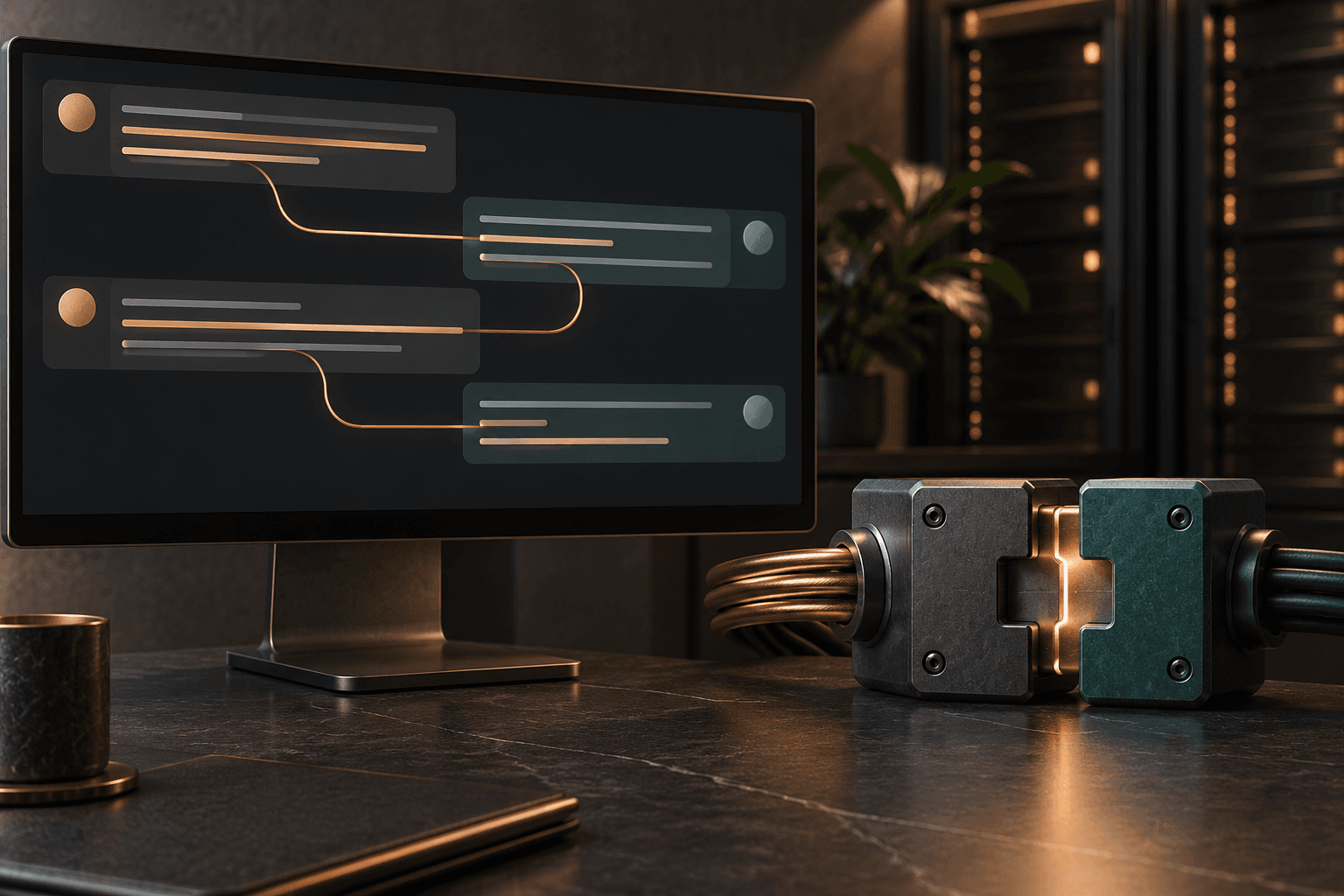
AI that does the work needs a pause button


It is easy to get stuck in chat mode. You ask AI to summarize an email, draft a reply, sort a list, or rewrite a text. It works. Then you do the same thing again next week, with almost the same prompt, almost the same files, and almost the same uncertainty about what actually happened.
That is where the next practical shift starts: AI workflows. Not as a huge IT program, but as a simple question for a small team: which AI tasks happen often enough to deserve a routine, an owner, and a pause button?
Mistral AI has released Workflows in public preview in Mistral Studio. The point is not that every small business should start writing Python tomorrow. The point is that vendors themselves are moving away from loose chat and toward runnable, visible processes: steps that can pause, be reviewed, resume, and leave a log. Zapier sees the same pattern in its agent survey: many organizations are testing agents, but human review remains the most common management model.
Source: Workflows for work that runs the business - Mistral AI
Source: State of agentic AI adoption survey 2026 - Zapier
From prompt to workflow
An AI workflow is a recurring process where AI handles a bounded part of the job with defined inputs, clear rules, a human checkpoint when needed, and a log showing what ran.
The difference sounds small. In practice, it is not. A loose prompt often disappears into chat history. A workflow can be improved. You can ask: what triggered it, which sources did it use, which rule stopped it, who approved the answer, and what did we change afterwards?
Mistral describes Workflows as a layer for AI processes that need durability, visibility, and fault tolerance. Their examples are large: cargo release, document compliance, support triage. But the mechanism works at a smaller scale too. A driving school, clinic, consultancy, or school office also has recurring tasks where AI can help, but where someone needs to pause before anything is sent, booked, or updated.
Mistral also shows a simple but important idea: a workflow can wait for a person. In its example, an approval point uses wait_for_input(), so the process stops until the right person says yes or no. That is a useful metaphor even if you never see the code. AI should not always get the next button. Sometimes it should prepare the recommendation and wait.
Source: Workflows for work that runs the business - Mistral AI
Why small teams should care
Small teams rarely suffer from not having yet another AI tool. The problem is usually that the day is already full of semi-structured work: customer questions, quote material, absence messages, course notes, supplier emails, meeting notes, and lists that should be followed up.
ChatGPT, Gemini, Claude, Copilot, Le Chat, and other tools can already help with a lot of that. But if every person solves the same task in their own way, the output becomes uneven. Someone pastes in too much data. Someone forgets to check the price list. Someone sends an AI draft without noticing that the tone is wrong. Someone else creates a genuinely good setup, but nobody can find it next time.
A small workflow does not solve everything. It does make the task visible.
It can be this concrete:
- A restaurant lets AI sort the week's catering requests by date, number of guests, and missing information. A human approves the reply before the customer receives anything.
- A school lets AI create the first draft of a lesson summary from the teacher's own notes. The teacher chooses what to share with students.
- A small ecommerce shop lets AI compare return requests with the return policy and suggest the next step. Refunds always require approval.
- A consultant lets AI turn meeting notes into a task list, but only after client names and sensitive details have been removed or redacted.
This is not an argument for slowing down. Quite the opposite. Small teams move faster when AI has rails instead of vague instructions.
The Mistral signal: workflows are becoming a product category
Mistral Workflows is interesting for Hammer readers for two reasons.
First, AI is moving closer to real business processes. Mistral writes about workflows that extract data, retrieve context, validate, cross-reference, request approval, generate a report, and execute an action. That is exactly the chain many small teams already do manually, except spread across email, documents, spreadsheets, and memory.
Second, the run log matters. Mistral emphasizes visibility, tracing, and OpenTelemetry in Studio. In plain language: you should be able to see what AI did, when it stopped, why it stopped, and which person took over. That is not only for large banks. It helps when a customer asks why they received a certain answer, when a principal wants to understand how a briefing was prepared, or when a small team wants to improve the routine without starting from scratch.
Source: Workflows for work that runs the business - Mistral AI
Mistral's Le Chat Enterprise points in the same direction. Mistral talks about enterprise search, document libraries, Google Drive, SharePoint, OneDrive, Gmail, Google Calendar, custom data and tool connectors, no-code agent builders, and access controls. Not every team needs that whole package. But the direction is clear: AI becomes more useful when it has the right context, the right permissions, and clear limits.
Source: Introducing Le Chat Enterprise - Mistral AI
The Zapier signal: control is not a side issue
Zapier reports that 72 percent of surveyed enterprise organizations are using or testing AI agents. For small teams, the percentage is not the most interesting part. What matters is what the agents are used for: data management, document analysis, support triage, and reports. In other words, the same administrative work that overwhelms micro businesses, associations, and schools.
Zapier also says human-in-the-loop is the most common management model in the survey, at 38 percent. That is a good anchor for small teams. You do not have to choose between "everything manual" and "AI runs free." The sensible middle ground is often: AI prepares the work, a human approves the decision, and the system logs the run.
Source: State of agentic AI adoption survey 2026 - Zapier
The 35-minute exercise: build a pause button on paper
Pick one task that comes back every week. Not the hardest one. Not the most sensitive one. Choose a task where you already think, "This should be easier to prepare."
Set a timer for 35 minutes and fill this in.
AI workflow: pause-button test
- Task: what should become easier?
- Trigger: when does the job start? Example: new email, new form response, new spreadsheet row, weekly planning.
- Inputs: which documents, rules, past replies, or lists may AI use?
- Forbidden actions: what may AI not do by itself? Example: send customer replies, change prices, book appointments, approve absence, pay invoices.
- AI step: which part should AI handle? Example: sort, summarize, suggest, compare, find missing information.
- Pause button: at what exact point must a person approve?
- Approver: who owns the decision?
- Run log: what should be saved after each run? At minimum: date, source, AI suggestion, human decision, and change made.
- Stop rule: when should the workflow stop and go straight to a person?
- First test: which three old cases can you try without sending anything externally?
Copy the prompt
Use this prompt in any AI chat. Replace the brackets.
You are my AI workflow designer. Help me turn a recurring task into a small, safe, useful routine.

Organization: [small shop, school, consultant, association, etc.]
Team size: [number of people]
Recurring task: [describe the task]
Tools we use today: [Gmail, Excel, Google Drive, Teams, Notion, other]
Goal: [what should become faster or clearer?]

Do this:
1. Write the workflow in no more than eight steps.
2. Mark which steps AI can handle, which steps a human must approve, and which steps the system should log.
3. Suggest a pause button: exactly where should the process wait for a human yes or no?
4. Suggest the smallest possible data access: which files, folders, or lists are needed, and what is not needed?
5. Suggest scoped permissions: read access first, write access only if truly needed.
6. Write three test cases: one normal case, one with missing information, and one where AI should stop and ask for help.
7. Finish with a short build brief I can give to a colleague, consultant, or automation technician.

Important: do not invent policies, prices, or rules. If something is missing, mark it as "missing".
Integrate safely without making everything heavy
Once the workflow makes sense on paper, you can start connecting it to real tools. Do it step by step.
Start with read access. Let AI read a limited folder, a test list, or an export before it can write back to any system. Keep API keys in environment variables or a secret manager, not in the prompt. Use scoped permissions so a workflow only reaches what it needs. Add approval for customer replies, money, personal data, and changes to important records. Save a run log that a human can actually read. Redact or mask sensitive details in test cases.
That goes a long way. You do not need a perfect AI platform to get value. You need a small routine where everyone can see where AI helps, where the human decides, and where the receipt lands.
Where Hammer can help
This is classic Tool Forge work. A team already has the task, the tools, and the irritation. What is missing is the drawing: trigger, data sources, permissions, pause button, test cases, and log.
If the team first needs a shared habit rather than a technical build, Skill Forge is the better fit. Then we train how to describe recurring AI jobs, review AI suggestions, and write rules that people can use every week.
Do not start with "which AI should we buy?" Start with one Friday task that always takes 45 minutes too long. Give it a clear start, a pause button, and a run log. That is where automation people actually dare to use begins.
The Forge newsletter
Get new articles in your inbox
Pick the topics you care about. No noise, at most one email a week.
We follow GDPR. Unsubscribe anytime.