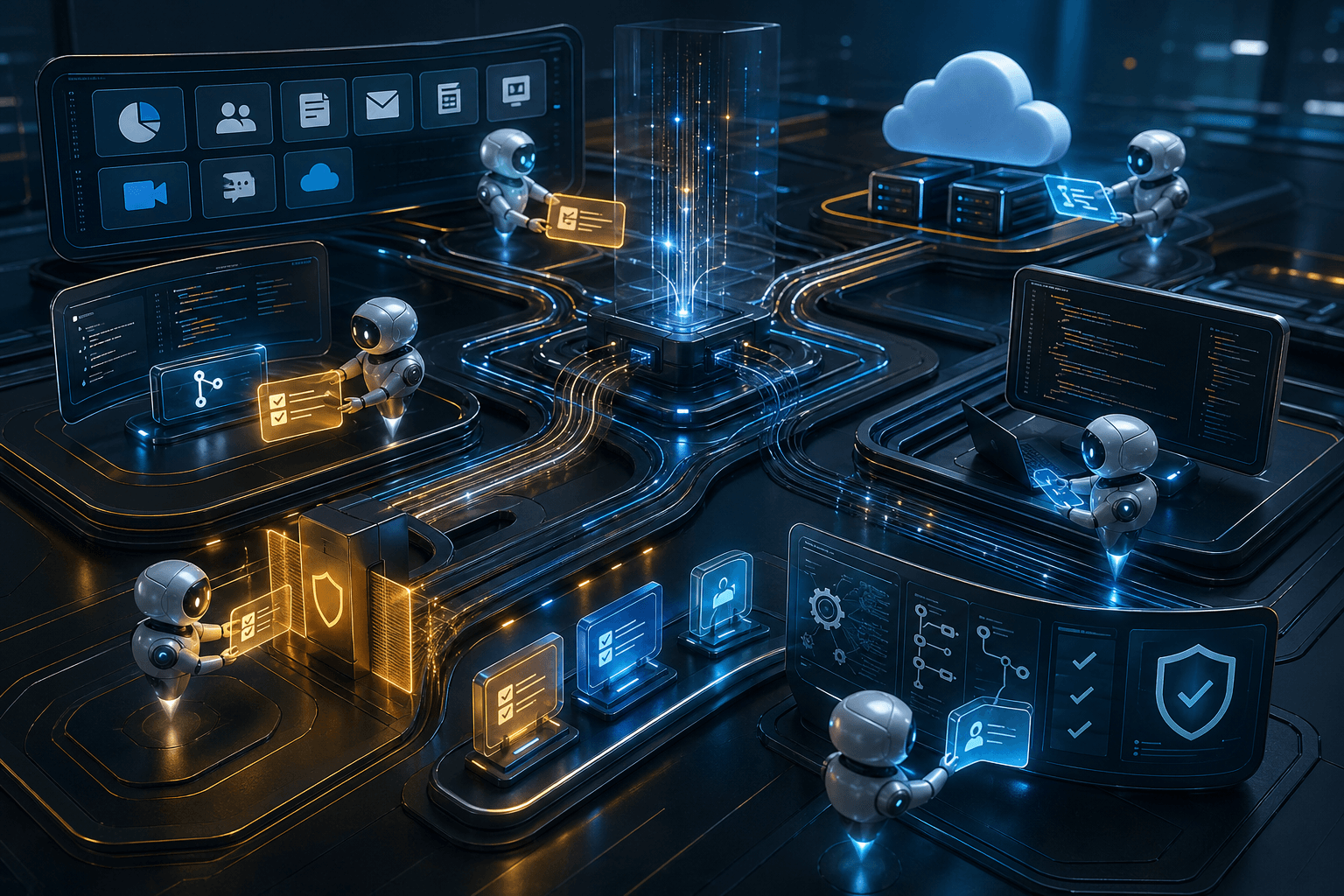
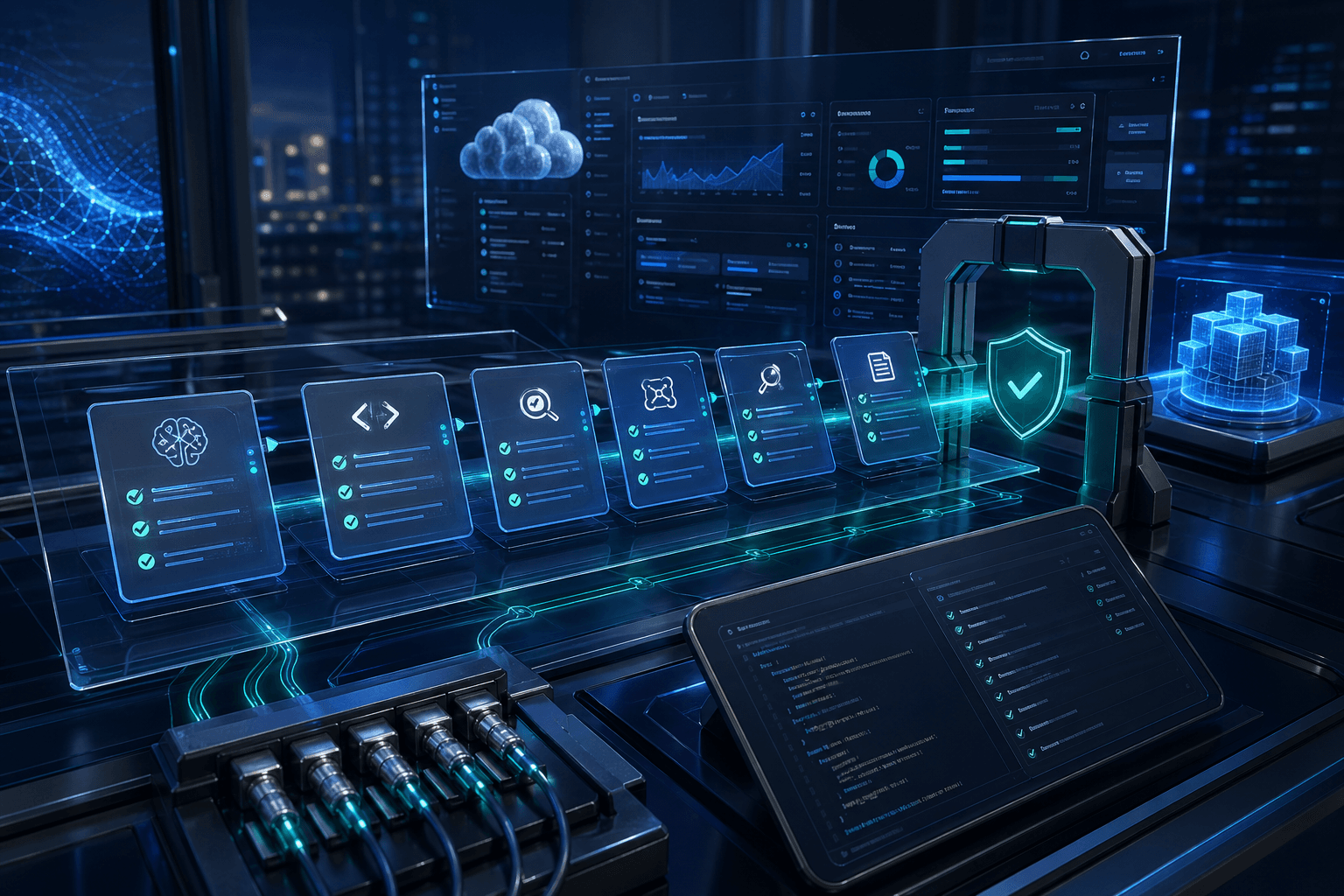
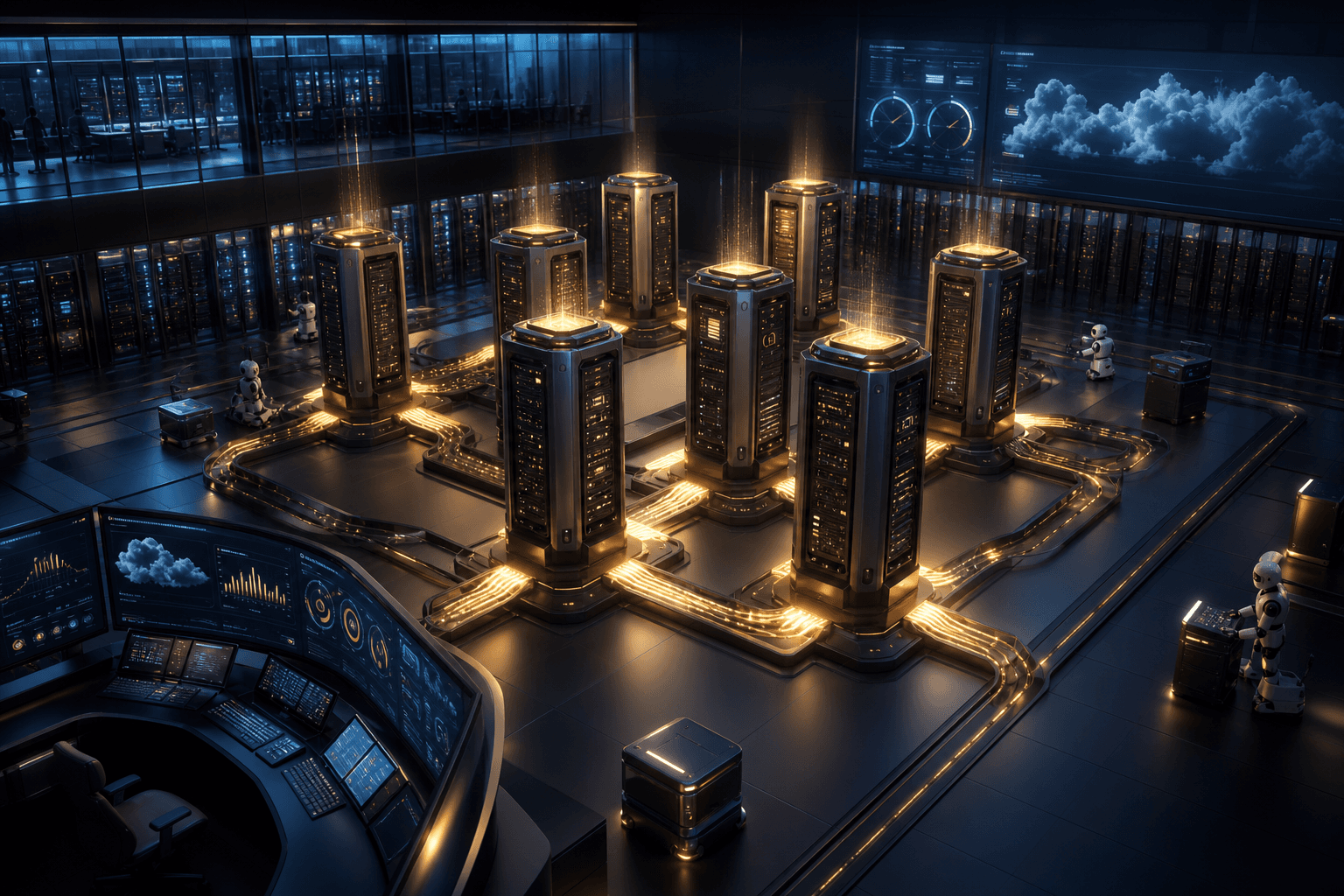
From Chat Toy to Load-Bearing Infrastructure — AI in April 2026

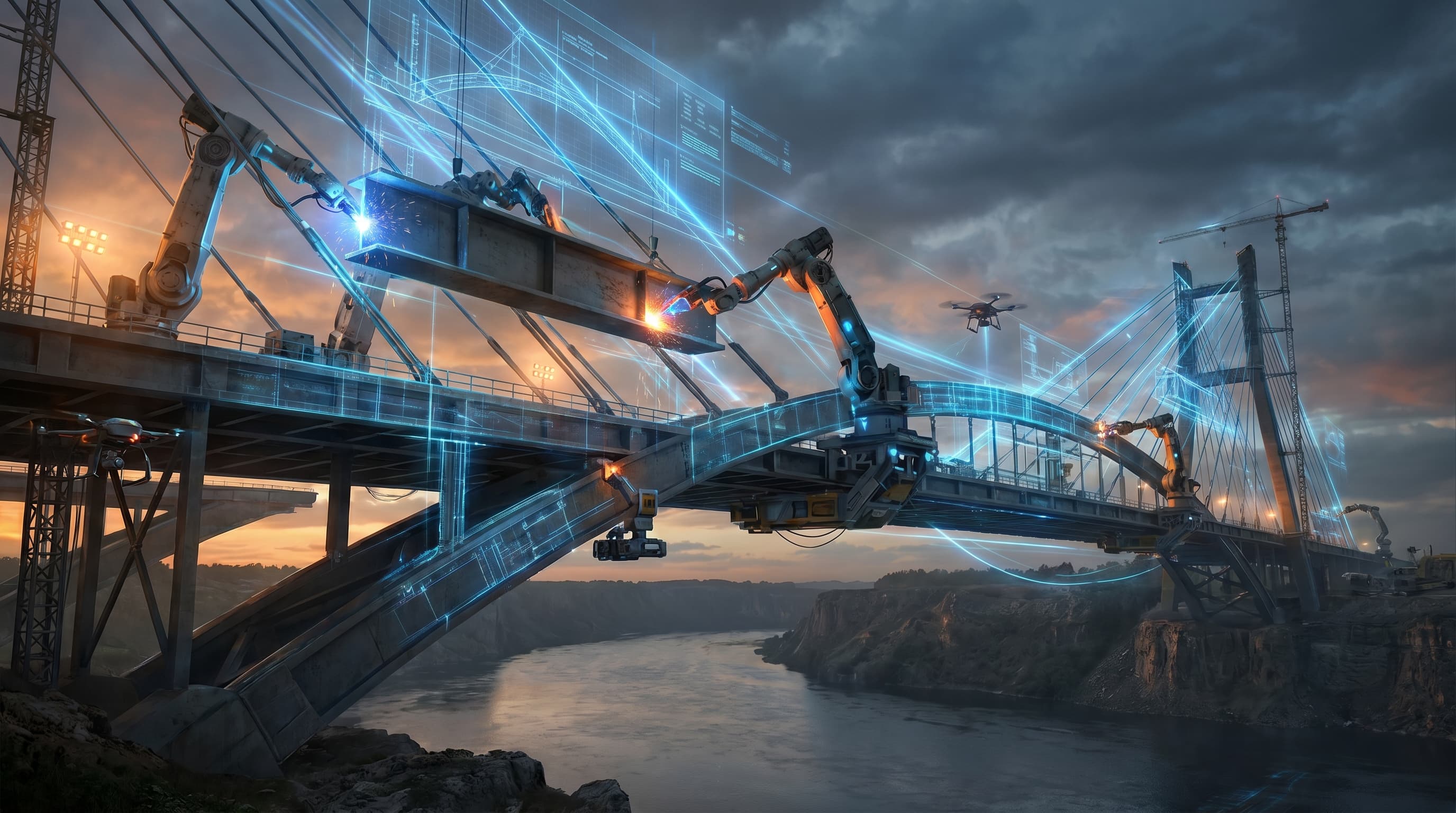
Summary: AI has stopped being a chat toy and become infrastructure. While a marketer can now create entire campaigns autonomously in their sleep, enterprises struggle with security in a world where agents execute code, update databases, and make decisions without human oversight. This is no longer a theoretical discussion — it is April 2026, and the shift has already happened.
The Picture: Two Worlds at the Same Office
Imagine an office where two completely different realities exist simultaneously.
At one desk sits a marketer with no technical background. While they took a nap, their AI assistant autonomously ran a complete multilingual ad campaign — from strategy based on internal financial data to publication. Everything happened without a human touching a keyboard.
Three desks away sits a senior software developer. Five complex compilations are running in the background, managed by AI agents that navigate a chaotic codebase in real time. Neither of them needed to ask for permission or wait for a code review.
This is what April 2026 looks like. The technology we dismissed a year ago as "a nice chatbot" has mutated into something entirely different. Anthropic, OpenAI, Mistral, Google, and Manus AI have all released updates that cement a new reality: AI is no longer an experiment — it is load-bearing infrastructure.
But as always when technology accelerates, there is an important question: where does the gravity center lie? And where do the risks hide?
Perspective One: The Command Line Is the Engine
One perspective argues that the real revolution is happening at the most unlikely place — the command line. The CLI. The dry, black window where developers have worked for decades.
Why here? Because this is where the real acceleration is greatest.
- Speed: A developer who previously needed days to refactor a library can now do it in hours with agentic help. Code compilations that required manual oversight now happen autonomously in the background.
- Depth of automation: The AI does not just navigate code — it executes commands, updates databases, and manages infrastructure. It integrates into the workflows that already exist, rather than requiring new interfaces.
- The productivity multiplier: For developers, this has meant a fundamental change in how work is performed. It is no longer about writing code line by line, but about leading agents toward desired outcomes.
The point is simple: everything else that gets built — marketing tools, consumer apps, analytics platforms — rests on the foundation of what developers can create faster and safer with AI-assisted workflows.
This is the infrastructure of infrastructure.
Perspective Two: The Consumer Is King
The second perspective sees things entirely differently. Technical improvements for developers are impressive — but they are secondary.
The real disruptive force lies not in which tools developers use, but in what consumers and non-technical users can suddenly accomplish.
- Democratization of expertise: The person without a technical background who created a complete market campaign autonomously — that is the revolution. Not that a developer compiles code faster.
- Market expansion: When millions of people can suddenly perform tasks that previously required entire teams, new markets are created. Small companies can compete with large ones. Individuals can build businesses over a weekend.
- Accessibility: Manus and Mistral have both focused on making agentic capabilities accessible through interfaces that do not require terminal skills. You do not need to know how to code to benefit from the AI revolution.
This perspective sees developer tools as a pipeline — necessary, but not what changes the world. What changes the world is what comes out the other end and reaches ordinary people.
The Agentic Shift: From Conversation to Execution
Both perspectives have one thing in common, however — they describe a world where AI has transitioned from being conversational to being agentic.
The time of treating these models as "nice chat widgets" is over. They no longer merely have answers to questions — they have the ability to:
- Plan: Break down complex tasks into steps and execute them in the right order.
- Use tools: Interact with external systems, APIs, and databases to retrieve or modify information.
- Autonomous decisions: Make decisions based on rules and contexts without asking for permission for each step.
- Iterate: Learn from results and adjust their behavior over time.
This is the fundamental change. Previously you got an answer. Now you get a work result. The difference is enormous.
The Security Problem: Tools Without a Guard
Here we reach the hardest part of the discussion. When AI goes from chatting to executing, the risk profile changes fundamentally.
Giving an AI agent access to databases, the codebase, and production systems is powerful — but it is also dangerous. Without proper security routines, the tools become a direct path into the heart of the system.
Central risks include:
- Unnoticed execution: Agents can run commands and make changes without a human seeing it in real time.
- Data exposure: When agents have access to internal data, there is a risk of leaks or misuse.
- The chain attack: An agent that has access to multiple systems can be used as a stepping stone for deeper intrusion.
- Liability confusion: When something goes wrong — who bears responsibility? The developer who wrote the agent? The agent itself? The company that deployed it?
This is no longer an academic question. Organizations implementing agentic systems must begin thinking like security companies: every tool an agent can use must be audited, every change must be tracked, and every execution must be auditable.
Mistral's "Thinking Signature": A Step Toward Auditability
In light of these security concerns, one specific technical innovation becomes particularly interesting.
Mistral has introduced what can be described as a "thinking signature" — a way to formalize how changes are verified through request chains. Instead of just trusting that an agent does the right thing, the system creates a cryptographically secure, auditable execution identity.
What this means in practice:
- You know exactly which part of the AI made which change.
- You can trace every decision back to its original instruction and context.
- An immutable log is created of what the agent did, when, and why.
This is more than just a technical novelty — it is a necessary evolution. When agents have the power to change systems, we must have the power to audit them.
It does not solve the whole problem, however. Auditability is necessary but not sufficient. It must be combined with:
- Principle-based access: Limit what agents can do based on their role and context.
- Human oversight: Critical changes should still require approval before being applied.
- Sandboxing: Let agents experiment in isolated environments before being unleashed in production.
Security cannot be an afterthought in an agentic world. It must be the foundation.
The Productivity Promise: What Is Actually Possible Now
Let us be clear about what this means in practice.
- A single marketer can now do the work that previously required a team of five — from data analysis to creative production and publication.
- A developer can parallel-run refactorings, tests, and documentation without manually switching context.
- An IT administrator can monitor and manage systems autonomously, with agents identifying and resolving issues before they escalate.
The potential is enormous. But the potential for chaos is also enormous.
It is easy to become fascinated by what is technically possible and forget to ask what is desirable. Not everything that can be automated should be automated. Not everything that can be executed autonomously should be executed autonomously.
The Future: Human Oversight in an Autonomous World
The question is not whether we should use agentic AI systems — that train has already left the station. The question is how we steward them.
This requires a new type of leadership:
- Technical leaders must become security architects as much as they are productivity optimizers.
- Non-technical leaders must understand the possibilities and risks sufficiently to make informed decisions about implementation.
- Organizations must build cultures where autonomy is balanced with accountability.
We stand at an inflection point. The coming months will define whether this technology becomes a democratizing force that lifts millions of people — or a concentrating force that benefits those who already have access to the best tools and knowledge.
Thoughts on how this affects the future
I have spent the last year almost exclusively in the terminal, working with coding agents day in and day out. What I have learned is that the technology is not the hard part. The hard part is the mindset shift.
When AI stops being a tool you use and becomes a colleague you lead, everything else must change with it — how you structure the codebase, how you think about security, how you communicate vision and responsibility. It is no longer about writing the perfect prompt, but about building a relationship with an entity that is both incredibly capable and totally dependent on your guidance.
This podcast episode mirrors exactly that: a discussion between two perspectives on the same change. Neither has the whole truth. Both are necessary. And both point to the same insight: we no longer have the luxury of treating AI as an experimental toy.
It is load-bearing infrastructure now. And infrastructure requires maintenance, security, and vision so as not to collapse under its own weight.
[Listen to the full episode on this page — the player is at the top of the post.]
The Forge newsletter
Get new articles in your inbox
Pick the topics you care about. No noise, at most one email a week.
We follow GDPR. Unsubscribe anytime.