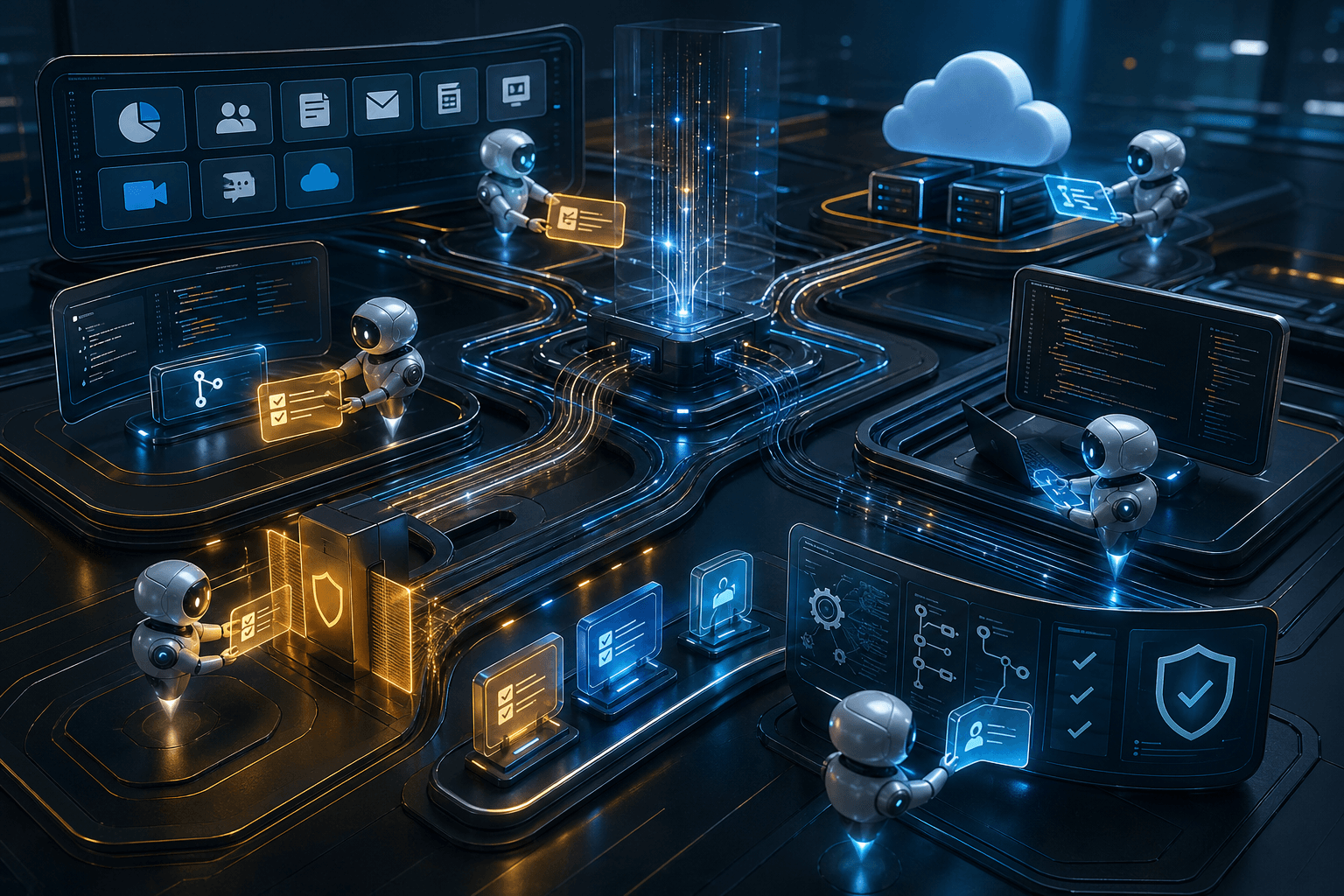
AI Enablement Radar week 33: give AI work a clear operating interface


This week's AI news points in one direction: AI work is moving out of private chat windows and into surfaces where more people can see, steer, and review what is happening. You can see it in Google Sheets, GitHub plugins, and Novo Nordisk's agent work. For a Nordic team, the next investment can be a clearer operating interface rather than another model.
An agentic workflow is a process where AI completes several steps, uses tools, and hands a result to a person for review. A person still needs a view that makes the workflow understandable and possible to lead.
Top signals this week
- OpenAI reports that companies in the top tenth of AI usage now generate 8.3 times more output per active user than typical companies. The gap was 2.6 times in January. Weekly plugin use is also higher, 21 percent versus 9 percent. That suggests a difference in depth of work, context, and tool access, rather than seat count alone. Source: OpenAI, How enterprises put AI to work.
- OneAdvanced built more than 50 task-specific agents in three weeks. Clinicians, product managers, and analysts can configure them in a visual builder without writing code. The useful part is the combination of domain knowledge, reusable tools, and a shared control point. Source: AWS and OneAdvanced, How OneAdvanced deployed over 50 AI agents.
- Google is launching Sheets canvas, a read-write surface that can turn a spreadsheet into a Kanban view, dashboard, or tracker. Changes in the view update the source sheet and vice versa. The initial launch is web-only and English-only. Source: Google Workspace Updates, Use Sheets canvas to visualize data.
- GitHub has released Agent Plugins 1.0 in VS Code, Copilot CLI, Copilot SDK, and the Copilot app. One package can carry both a prepared work instruction and its tool connections, with admin controls for plugins, marketplaces, and MCP servers. Source: GitHub Changelog, Agent Plugins 1.0.
- Novo Nordisk already has more than 25,000 employees using generative AI and is moving on to AI agents, biological models, and a joint innovation hub with AWS. The adoption sequence is clear: everyday work first, then specialized workflows. Source: Novo Nordisk, strategic partnership with AWS.
- The European Commission's new labelling icons and Anthropic's planned text watermarking put provenance inside the publishing workflow. The icons are optional tools, while disclosure is mandatory for certain kinds of AI-generated or manipulated content. Source: European Commission, EU Icons for labelling AI-generated content. Source: Anthropic, How Claude's text watermark works.
What organizations are actually doing with AI
Novo Nordisk builds on broad everyday use
Novo Nordisk is tying its next step to a base that already exists. The company says more than 25,000 employees use its generative AI solution for information retrieval, document drafts, chatbots, and support in non-regulated processes. Its AWS partnership now covers Amazon Bedrock AgentCore and work across genomic, imaging, and clinical data.
The pattern also applies far outside pharmaceuticals. A team can first make one shared work surface useful to many people, then build deeper connections where the value and accountability are clear.
Source: Novo Nordisk, strategic partnership with AWS.
Domain experts become tool builders
OpenAI describes a finance employee with no previous coding experience who used Codex to turn a monthly advertising forecast into daily and weekly planning tools. An internal GPT for investor relations also reduced the first-draft stage from hours, sometimes overnight, to seconds. People still review the result.
This does not mean every finance professional needs to become a developer. The tool improves when the person who understands the forecast can also shape the surface, fields, and approval step.
Source: OpenAI, What building an AI-native finance function taught me.
Schools get a view of the writing process
Grammarly Authorship is now integrated with Blackboard. Students can show how their text was created, while instructors get a class-level view and can open an individual writing process when needed. Grammarly says more than five million Authorship reports have been generated. In a vendor-published case, Rowan-Cabarrus Community College reduced academic integrity violations from 27 to 1 in one semester.
That is more useful than a single detection score. The school gets evidence it can discuss with the student, while still needing its own rules for how that evidence should be interpreted.
Source: Grammarly, Authorship is now available in Blackboard.
More agents need one shared operator view
OneAdvanced describes more than 50 production agents for care incidents, education planning, HR reviews, and legal research. Most were built in less than a day inside one shared platform, but the jobs are bounded, and the tools are reusable.
A smaller team can apply the same pattern: give each agent a clear job, show status and sources in one view, and make the next human decision visible.
Source: AWS and OneAdvanced, How OneAdvanced deployed over 50 AI agents.
The tooling layer: platforms, agents, and workflows
Google Sheets canvas turns the work surface into the product
Many teams already keep their operational truth in a spreadsheet. Sheets canvas adds an interactive surface over the same data, with direct updates in both directions and the sheet's existing sharing settings. A customer flow, case queue, or follow-up process can gain a clearer shape without starting a separate systems project.
Begin with a view that answers three questions: what is waiting, what has AI done, and what needs a decision?
Source: Google Workspace Updates, Use Sheets canvas to visualize data.
Agent Plugins 1.0 packages the instruction and the tool
MCP, the Model Context Protocol, is an open way for AI clients to connect to external tools and data sources. With Agent Plugins 1.0, an organization can package a skill, an MCP configuration, and client-specific additions in one structure. GitHub also describes controls through enabledPlugins, approved marketplaces, and MCP allowlists.
This cuts duplication, but it also puts the plugin owner in focus: who updates the instruction, who approves the server, and which permissions are granted?
Source: GitHub Changelog, Agent Plugins 1.0.
Speed becomes part of interface design
OpenAI is previewing Ultrafast for GPT-5.6 Sol at up to 750 output tokens per second and up to 14 times Standard processing speed. Access is limited. The broader practical lesson still matters: faster models make voice support, live incident work, and other interactive workflows possible without long pauses.
Measure the full wait time in the workflow, not just a model benchmark. Retrieval, tool execution, and the human decision can still be the slow parts.
Source: OpenAI, Previewing Ultrafast mode.
Regional inference becomes an architecture choice
Mistral Regional Endpoints are now generally available with a choice between processing in Europe and the United States. The company also offers a public preview of Priority Tier with custom rate limits and an uptime SLA. Mistral notes that limited, safeguarded transfers to subprocessors outside the selected region may still occur.
For a Nordic team, region, supplier dependence, and the fallback route belong on the integration card beside the model choice, not in a forgotten appendix.
Source: Mistral AI, In-region inference, open models, and new European infrastructure.
Governance and risk: what needs to be in place before scaling
Governance does not need to dominate every AI conversation. It does need to be present in the work surface where decisions are made.
The European Commission's icons offer a concrete way to label certain AI-generated or manipulated text, images, audio, and video. For text about matters of public interest, an exception applies when a person has reviewed the material and someone assumes editorial responsibility. The icon supports disclosure; it is not proof of full compliance.
Source: European Commission, EU Icons for labelling AI-generated content.
Anthropic, meanwhile, plans text watermarking based on probability patterns in word choice. It adds no hidden characters or person-level identification. The company says detection weakens for short, factual, code-heavy, or lightly edited text. A watermark can support source records and an editorial log, but it cannot replace them.
Source: Anthropic, How Claude's text watermark works.
The European Commission's new cloud and AI study also points to lock-in across the AI stack, risks from third-country laws, and the EU's dependence on non-European suppliers. That gives buyers a simple question: can we move our data, instructions, and evaluations if the supplier changes its terms?
Source: European Commission, Study on Cloud and AI Development in the EU.
Anthropic's multiagent tests show why a clear operator view matters even when each agent appears reasonable. A coordinated group of 45 agents found 266 vulnerabilities using 27 million tokens, compared with 21 findings from independent agents using 6.5 million tokens, though the experiments differed in scope. In other tests, 18 of 30 agents chose the same branch name, and a finite queue received 2.4 million requests but accepted 117 jobs. Measure queues, resource limits, and coordination failures as well.
Source: Anthropic Frontier Red Team, Patterns and problems in emerging multiagent systems.
This week's practical Hammer test
Build a simple operator view for one recurring AI workflow in 40 minutes. Pick a follow-up process that already starts in a spreadsheet, inbox, or case list.
- 0–8 minutes: Choose work that returns every week and write what an accepted result must contain.
- 8–18 minutes: Draw four states:
New source,AI draft,Needs decision, andDone. - 18–28 minutes: Decide one action AI may take, one that needs approval, and one source field that must always be completed.
- 28–36 minutes: Build the view in a tool you already use. An extra sheet, database view, or simple Kanban board is enough.
- 36–40 minutes: Run one historical example. Record time, missing sources, errors, and the final human decision.
Use this prompt to get a first structure:
I want to make this recurring work visible and reviewable: [describe the work]. Propose an operator view with status states, required source fields, one action AI may take, one action that needs human approval, and a short run receipt. Use [Sheets/Notion/CRM/other] as the starting tool. Ask no more than three questions about missing information before drafting the view.
This is a typical Tool Forge engagement: turning a good work card into a working integration with scoped permissions, secrets held in environment variables or a secret manager, approval points, and a log people can inspect.
Companies and tools to watch
- Google Sheets canvas: whether its read-write surface makes spreadsheets useful as operator interfaces for teams without developers. Google Workspace Updates.
- GitHub Agent Plugins: whether one shared package actually reduces the work of maintaining skills and MCP servers across agent clients. GitHub Changelog.
- Novo Nordisk: how broad employee adoption connects to specialized agents and research workflows. Novo Nordisk.
- Mistral Regional Endpoints: how European processing, capacity commitments, and open models combine in real procurement. Mistral AI.
- Anthropic's watermarking: how the forthcoming detection API and C2PA metadata are used without treating them as certain proof of authorship. Anthropic.
FAQ
What is an operator view for an AI workflow?
It is a shared view of the task, status, sources, AI output, pending decisions, and run log. It lets a person understand and lead the workflow without reading the entire chat history.
How can a team test this without a large systems project?
Choose one recurring workflow and build four states in a tool the team already uses. Run one historical case and measure time, missing sources, errors, and the human decision.
Which controls are needed when AI connects to real tools?
Use scoped permissions, environment variables or a secret manager for secrets, required source fields, approval before consequential actions, and a log for every run.
The Forge newsletter
Get new articles in your inbox
Pick the topics you care about. No noise, at most one email a week.
We follow GDPR. Unsubscribe anytime.