Your AI series needs a director
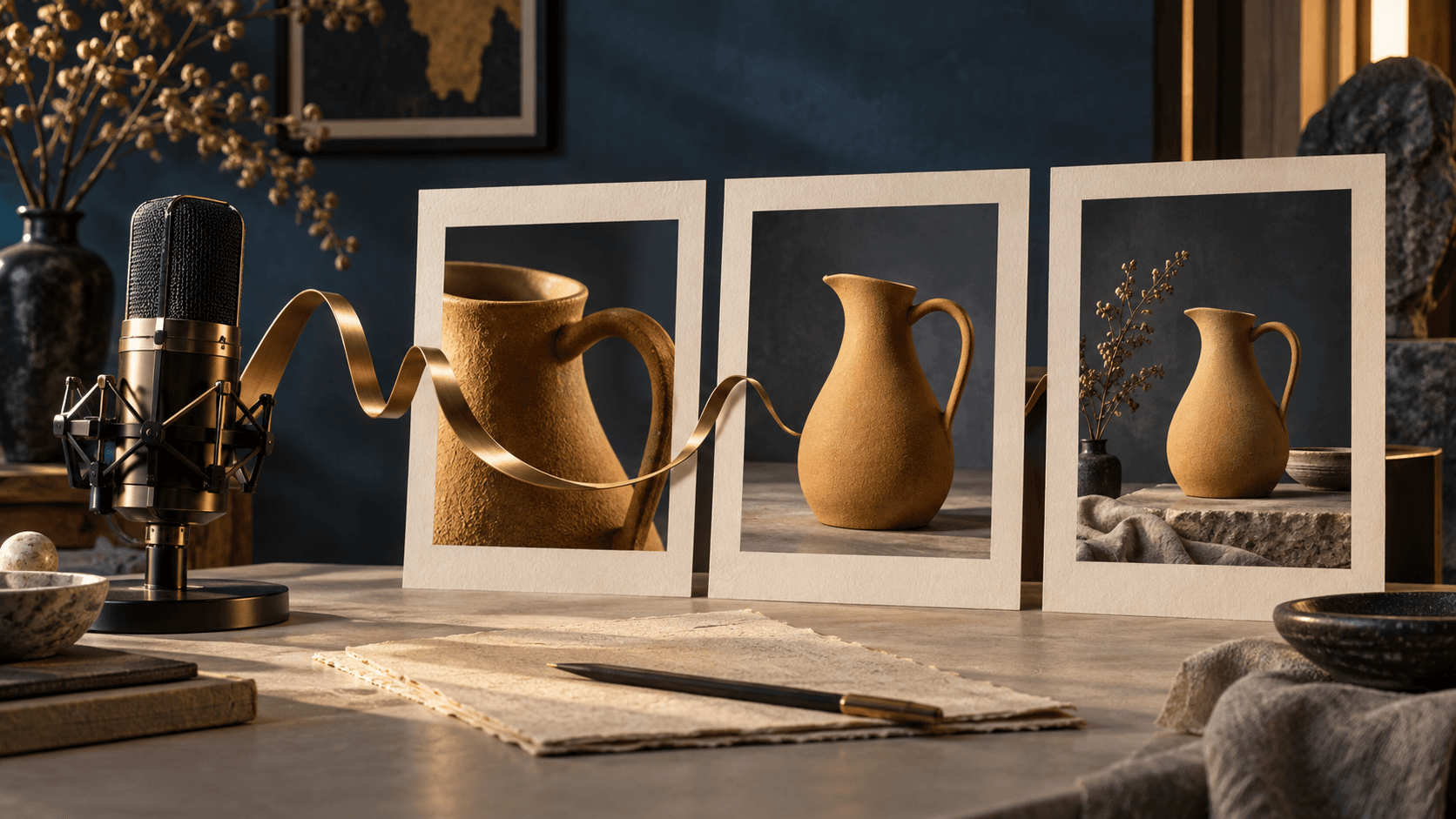
A pottery studio can generate a convincing AI video about a pitcher. The next video is harder: the narrator should be recognizable, the product should keep its shape, and the story should be worth following. That hypothetical example captures this week's creative question. As more people gain access to good images and sound, a distinctive recurring idea matters more than generation alone.
Our thesis is that the advantage in AI production increasingly lies in direction: the choices that make the next episode recognizable and relevant. Google's new voice tools and Grok's new video controls give that possibility a concrete basis. They do not prove that a series will be good or sell more.
The English podcast above draws on Hammer Automation's provider research from September 21–27, 2026. Here we explore the creative consequence; the episode's source material also covers OpenAI, Anthropic Claude, and Mistral.
Gemini separates vocal identity from performance
Text-to-speech, often shortened to TTS, turns a written script into spoken audio. On September 23, Google introduced Gemini 3.8 Flash TTS and Flash-Lite TTS. One important capability is creating a voice from a description, saving it, and using it again. That is different from choosing a new voice for every video.
Google's documentation also separates the voice's underlying character from the delivery of an individual line. Timbre and accent belong in voice design. Emotion and delivery can be directed line by line. A recurring narrator need not sound as excited in a care instruction as in a product launch.
For the pottery studio, that could mean a calm narrator returning in videos about glaze, care, and production. This is a hypothetical use case, not a customer production we have tested. Pronunciation and output still need to be assessed in the language being used.
Designing a new voice is also separate from replicating a real person's voice. Google's launch note says voice replication through AI Studio is unavailable in the EEA. A Swedish organization should not read a global demonstration as a promise of local access.
Grok gives the visual story fixed reference points
On September 24, version 1.20.0 of xAI's Python package added last-frame and keyframe support for video generation. A keyframe specifies what the image should look like at a particular moment in a clip. With Grok Imagine Video 1.5, a creator can specify more of the sequence than a description of the desired mood.
The difference is practical. The studio could start with a chosen opening image, show the pitcher in a particular intermediate state, and finish with a chosen product shot. The motion between them is generated. The creative job becomes deciding what each image should communicate, rather than asking for a beautiful video and hoping for the right ending.
There are firm limits. The documentation specifies up to four interior keyframes, a maximum duration of 15 seconds, and 720p for this kind of reference-guided video. Fixed reference points do not guarantee that the handle, glaze, or any lettering stays correct between them. A product claim must remain true even when the motion is generated.
A series needs a reason to return
It would be easy to use the new controls to make more nearly identical advertisements. That is also the thesis's weakest point: consistency can make a dull idea more consistently dull.
A better question is what the audience gets from the next episode. The studio could have each video answer a real question about a material or show a production step customers rarely see. The voice and visual style hold the series together; the content gives people a reason to return. The tools can help with the former. The latter still takes audience knowledge and a script with something to say.
If the thesis holds, some effort should move from requesting more variations to developing a format that can sustain several episodes. That is a creative priority, not a promise of lower production costs.
The rest of the AI week has different drivers
This week's research also covers OpenAI Sol and Luna, Anthropic Opus 5.5, Grok 4.7, and Mistral's tooling and distribution changes. They belong in the broader discussion, but should not be squeezed into a story in which every provider suddenly becomes a film studio. The source material distinguishes new launches from older announcements recovered later.
For someone developing a recurring format, a useful first attempt is to write two different episodes around the same creative idea. If the second has nothing of its own to say, more generations will not help. To explore how that format could be produced with AI, describe the idea to Hammer Automation.
The episode is an AI-generated masterclass created with NotebookLM from Hammer's deep daily research into AI providers' updates and features. This article draws on the same research and a NotebookLM synthesis, not an audio transcript. We did not test the production features described here during this run.
The Forge newsletter
Get new articles in your inbox
Pick the topics you care about. No noise, at most one email a week.
We follow GDPR. Unsubscribe anytime.