AI's next breakthrough may be knowing when to stay silent

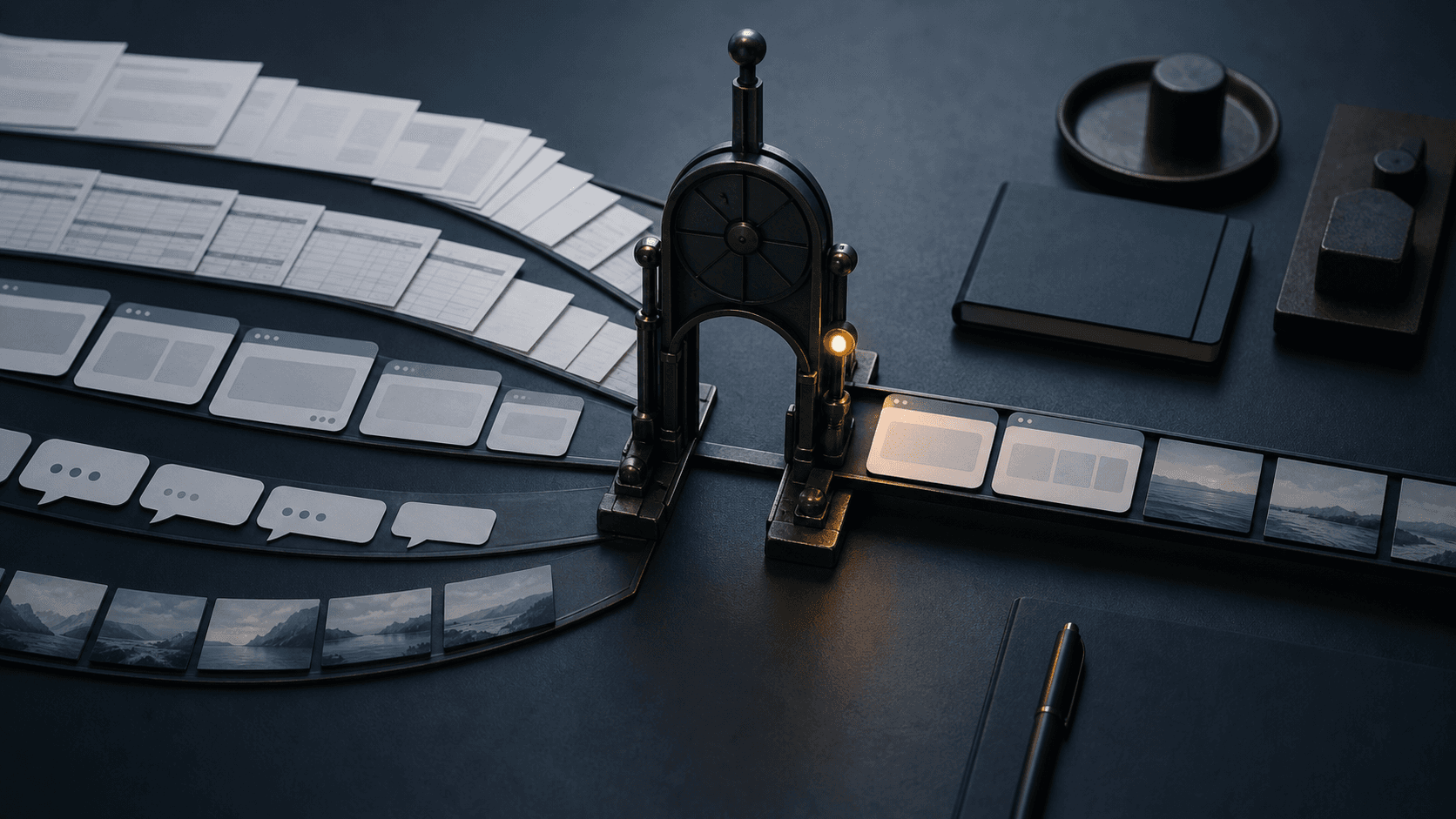
The most interesting AI feature this week did nothing at all.
Claude Tag can now read the context of a Slack channel and choose among four behaviors. It can reply, start deeper work, route new information into work already underway—or remain silent. Anthropic reports roughly a 30% improvement in deciding when Claude should intervene. That is the vendor's own measurement, but the product idea is larger than the number.
The AI market has spent years competing over who can produce the best answer to a prompt. Week 33 pointed to a different contest: who enters the work at the right moment, with the right context and enough restraint.
If that thesis holds, the buyer's test changes too. The question is no longer only “How well does the model write?” It becomes “When should it appear—and when should it stay out?”
The week's most important feature may be a missing reply
An assistant that always responds is easy to demonstrate. It is not always easy to work beside.
In a busy channel, one more long AI response can create more sorting than help. Claude Tag now uses channel history, memory, and standing instructions to decide whether to participate. This does not mean the system has acquired human judgment. It means the product's job has moved: from composing an answer to first deciding whether an answer is needed.
That distinction matters. A good intervention might be a summary before a meeting, an anomaly raised when the numbers change, or a question when the evidence is thin. A bad intervention can be factually correct yet arrive too late, interrupt the wrong person, or repeat something the group has already resolved.
Timing is therefore a quality dimension of its own. A standard model leaderboard cannot measure it.
Work memory gets a new job: controlling timing
Last week's masterclass examined how the work memory around a model may be harder to move than the model itself. Week 33 showed the next step: vendors are using context to decide what the product should do now.
OpenAI introduced Computer History, where selected events from apps and websites can give ChatGPT and Codex a searchable timeline. OpenAI says the feature does not record screenshots, audio, or private browsing. Google Drive Library places documents beside the conversation and, with the appropriate authority, can also work against the source.
Anthropic's Cowork in Chrome lets a task continue across the browser, desktop, web, and mobile. Google approaches the same idea from another direction: Sheets canvas can create small read/write applications over spreadsheet data, while Pixel 11 expands multistep actions across more than 40 apps.
The common thread is not simply “more memory.” Context is being used to reduce restarts and select the next move. A person does not need to begin every task by retelling what happened five minutes ago.
But context is not judgment. If an assistant reads the wrong signal, it simply gets the chance to be wrong faster and more smoothly. The real test is whether it finds the right moment, not whether it can collect more data.
More speed helps only after the moment is right
OpenAI says the preview of GPT-5.6 Sol Ultrafast can run up to 14 times faster than the Standard tier and reach up to 750 output tokens per second. Those are vendor-reported maxima for selected customers, without a public price or service-level agreement.
Speed can still change a workflow. Analysis that once ran overnight may become a conversation in which the hypothesis changes during the meeting. Customer service may be able to reason and use tools without losing the rhythm of the exchange.
Yet tokens per second are only one part of the wait. Retrieval, tools, human review, and external systems can remain the bottleneck. If AI intervenes at the wrong point, higher speed mostly makes the interruption arrive sooner.
Google gave the same question an economic dimension with Gemini 3.7 Flash. The model offers low, medium, and high thinking levels, a context window of just over one million tokens, and introductory pricing that doubles on January 1, 2027. More effort can be selected per task, but it should be tied to value: fewer retries, better completion, or shorter real lead time.
Creative AI work moves from restarting to the next controlled version
xAI's Imagine Image 2.0 shows what timing can mean outside office administration. On August 10, the new editing environment was available to consumers but had no public API identity. By the week's later check, the model appeared as grok-imagine-image-2.0, with pricing and an API contract.
The interesting part is not simply that another image model can be called. The unit of work changes from “write a new prompt” to “take the approved idea one step further.” Regional edits, background removal, multiple reference images, and adaptation to new aspect ratios make it possible to preserve what already works.
For a marketing team, that can mean fewer restarts. An approved campaign image can become a new size or local variation without regenerating the whole composition. The useful metric is no longer how impressive the first image looks, but how well identity, layout, and message survive five controlled edits.
Not every consumer capability maps directly to an API parameter. Human visual review therefore still belongs in the workflow. But the direction is clear: AI is not only being asked to create. It is being asked to recognize which step in the creative chain comes next.
Timing loses to an HTTP 403
The strongest objections this week came from Perplexity and Mistral.
Perplexity moved Gateway API into private preview. A valid API key is no longer enough; the account also needs entitlement, or Gateway returns HTTP 403. The public quick-start guide still described a self-service route at the time of the research. A correctly built system can therefore stop because the access contract changed underneath it.
Mistral had two incidents that had remained open for more than 61 hours at the report cutoff, followed by another cluster of disruption. No root cause had been published. The point is simple: an assistant can choose the right moment only if the service is reachable.
Reliability, access, and cost are not side notes. They define the frame in which product behavior operates. The bold thesis therefore needs a footnote: timing may become the next competitive surface, but it does not replace a functioning base contract.
Replace the model test with a moment test
Do not test the next AI assistant only by asking ten questions in an empty chat window. Choose a real moment of work and observe three things:
- Entry: does the assistant notice when help is genuinely useful?
- Handoff: does it use the right context without making you retell everything?
- Restraint: can it wait, ask, or remain silent when uncertainty is high?
This is not another generic “responsible AI” checklist. It is a product test. An assistant that writes best but interrupts the wrong person at the wrong time may be worse than a simpler model that fits the rhythm of the work.
If you map a workflow with Hammer Automation, do not begin with the model name. Begin with the moment: When should AI enter this workflow—and when should it stay out?
This podcast episode is an AI-generated masterclass built from Hammer Automation's deep daily research into AI-provider updates and features, processed with NotebookLM. The article uses the same source material and is not a transcript of the episode.
Source basis: Hammer Automation's AI-generated masterclass research, based on daily deep research into each provider's updates and features.
FAQ
What does timing mean for an AI assistant?
It means when the assistant enters a workflow, which context it uses, and whether it can wait, ask, or remain silent when an intervention would not help.
Does Anthropic's 30% figure prove Claude Tag always chooses correctly?
No. It is a vendor-reported improvement in deciding when Claude Tag should respond. It is a useful product signal, not independent proof across every Slack environment.
How can a team test whether an AI assistant intervenes at the right time?
Use a real work moment and measure three things: whether help arrives when useful, whether the right context follows, and whether the assistant can abstain when evidence is weak.
The Forge newsletter
Get new articles in your inbox
Pick the topics you care about. No noise, at most one email a week.
We follow GDPR. Unsubscribe anytime.