Google Finance in Europe: AI market checks for small teams

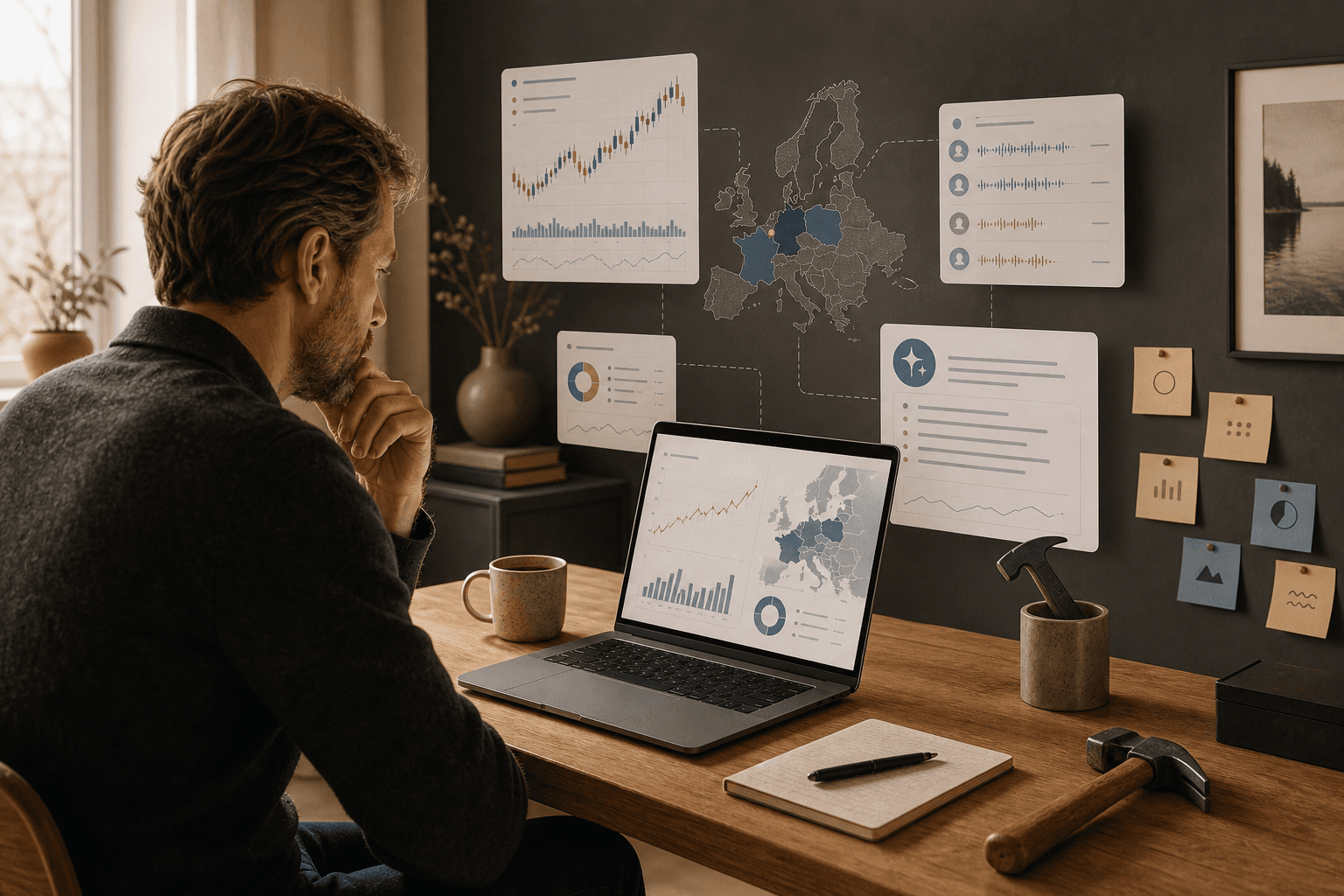
When Google brings AI summaries, deeper search and earnings-call transcripts into Google Finance in Europe, financial market monitoring is no longer something only larger companies do with expensive tools. For a small Nordic team, the practical signal is more grounded: understand customers, suppliers, and markets faster before the next sales, purchasing, or planning decision.
Source: Google Blog – The new AI-powered Google Finance is expanding to Europe
What changed in Google Finance in Europe
Google wrote on May 11, 2026, that the new AI-powered Google Finance experience is launching across Europe with local language support. The experience lets users ask about stocks and broader market trends, receive AI responses with links, use more advanced visualizations, follow real-time news, and access earnings calls with live audio, synchronized transcripts, and AI-generated insights.
Source: Google Blog – The new AI-powered Google Finance is expanding to Europe
AI-powered research here means that a user can ask a plain-language question and receive a synthesized, linked overview instead of manually jumping between news sites, charts, company reports and call transcripts. It is not a decision system; it is a faster first analysis view.
Google Search Help states the limitation clearly: Google Finance and its AI features are for generic financial information, not personalized investment, tax or legal advice. AI can make mistakes, and financial data should be independently verified before it is used for decisions.
Source: Google Search Help – Try AI-powered Google Finance in Search
Why this matters for small Nordic teams
The practical point is not that a business owner should become a day trader. The practical point is that market understanding becomes more accessible.
For a small service business, that can mean:
- Before a sales call: ask what is happening in a customer's industry before proposing an offer.
- Before purchasing: compare commodity, currency, or market signals before committing to costs.
- Before planning: follow earnings calls and news flows for larger customers, suppliers, or competitors.
- Before teaching: let students review how AI summarizes market news, and where human source criticism is still needed.
This is a useful reminder that AI productivity is not only about writing faster. In small teams, it often means making the first orientation less messy, so the owner, school leader or operations lead can spend more time on judgment.
Test today: a 30-minute market check
A simple routine is better than a large AI project. Pick one customer group, supplier, or industry that affects your work and run a short, source-critical review.
Prompt to use in an AI tool or as a work instruction:
Help me run a 30-minute market check for [industry/customer group]. Summarize three current signals, link to the sources, separate facts from interpretation, and suggest two questions I should ask before making a business decision. Clearly mark what needs to be manually double-checked.
This maps naturally to Mindset Forge: before automating decisions, the team needs to decide which questions AI may prepare, which sources count as sufficient and where a human must approve the conclusion.
What to watch next
Google also describes Deep Search in Google Finance as a feature for more complex questions where Gemini models can run many simultaneous searches, reason across different pieces of information and produce a more comprehensive answer with citations. That is powerful, but for small teams the control question becomes more important as the answer looks more complete.
Source: Google Blog – Google Finance launches new AI-powered features including Deep Search
So do not only watch whether the tool gets smarter. Watch whether your workflow gets clearer:
- Which questions may AI answer directly?
- Which sources must always be opened and read?
- What decisions require an external advisor, board, principal, or owner?
- How do you save links, assumptions, and manual checks so the decision can be reviewed later?
Thoughts on how this affects the future
The larger signal is that AI is moving into specialized work surfaces: finance, education, design, customer service and administration. That makes AI less like a separate chat window and more like an analysis layer on top of everyday tools.
For Hammer Automation's audience, the winner is not the team that trusts AI the most. The winner is the team that builds small, clear routines where AI reduces information chaos while humans still own responsibility, values, and decisions.
The Forge newsletter
Get new articles in your inbox
Pick the topics you care about. No noise, at most one email a week.
We follow GDPR. Unsubscribe anytime.