AI agents are becoming work environments: what small teams should test now

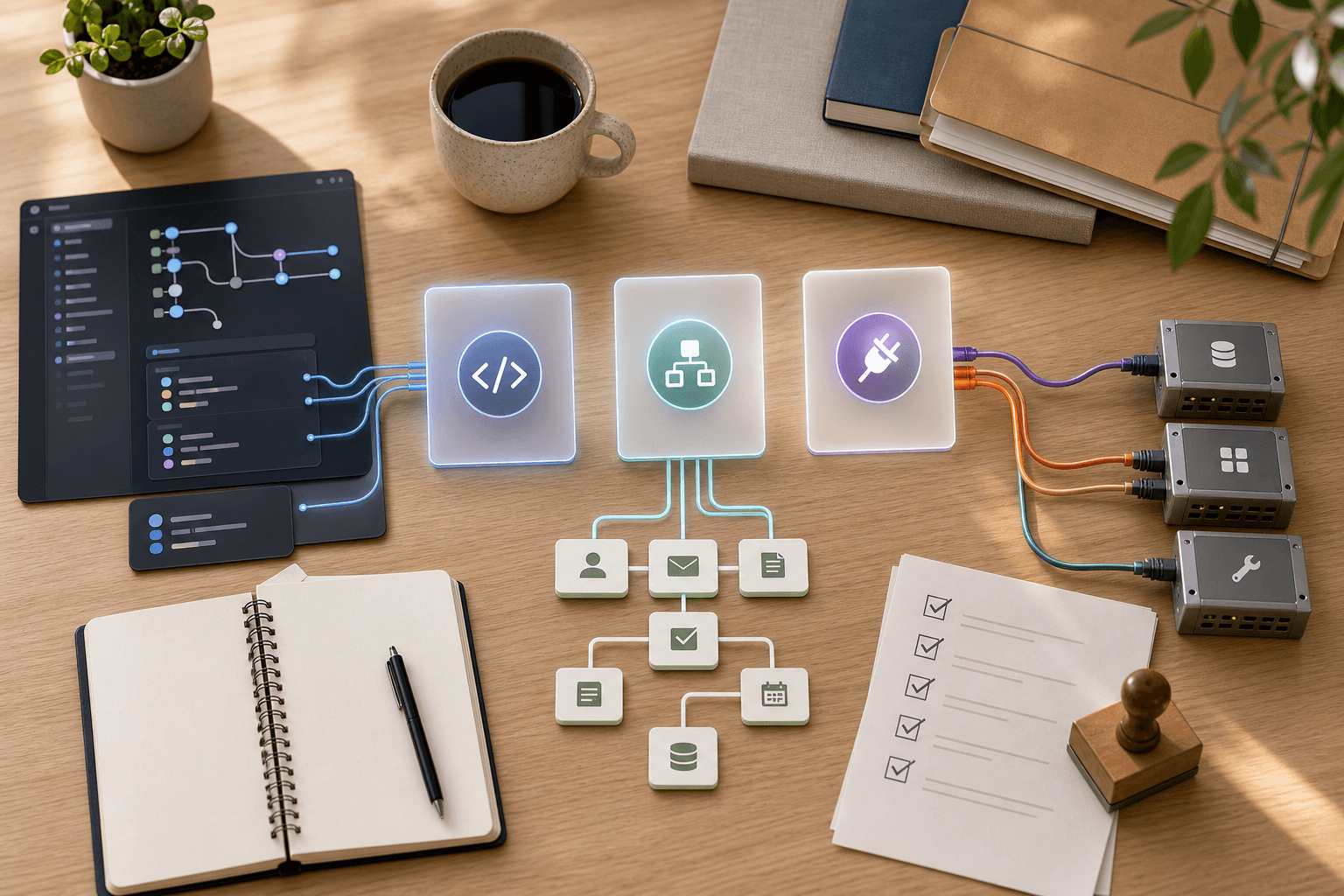
AI agents are moving from developer-terminal experiments into everyday workflows where small teams can actually get help with administration, follow-up and repetitive decisions. This week’s strongest signal is not one new model, but that OpenAI Codex, Claude Code, GitHub Copilot and Microsoft Copilot Studio are all building the same direction: more controllable agents with tools, memory, approvals and clearer work environments.
What is changing: agents get tools, rules and a workspace
An agentic workflow is a workflow where AI does not just answer a question, but plans next steps, uses tools and asks for approval when an action could affect files, data or customers. That makes the technology more relevant even for organizations that do not build AI systems every day.
OpenAI’s Codex changelog describes how Codex CLI received more persistent /goal workflows, clearer permission profiles, plugin workflows, hooks and external agent session import in April. The direction is clear: AI assistants are becoming work environments, not just chat boxes.
Source: OpenAI Developers – Codex changelog
Claude Code shows the same pattern from another angle: recent notes focus heavily on stability, sessions, permission modes, hooks and MCP robustness. That sounds less dramatic than a new model, but for a business it is often exactly what determines whether an AI workflow can be trusted.
Source: Claude Code Docs – changelog
MCP makes external tools a standardized part of the agent
Model Context Protocol (MCP) is an open standard for connecting AI agents to external systems, data sources and tools through a shared interface. In practice, it means an agent can get controlled access to documents, tickets, browser tests, business systems or internal knowledge sources.
Microsoft now explains how Copilot Studio agents can be extended with MCP tools and resources. When an MCP server publishes a tool or resource, it becomes automatically available to the agent, and changes are reflected dynamically. That matters for smaller organizations because integrations can become reusable instead of being rebuilt for every bot.
Source: Microsoft Learn – Extend your agent with Model Context Protocol
GitHub is moving in the same direction. Copilot for JetBrains now has custom agents, sub-agents and plan agent generally available, plus preview support for agent hooks and automatic MCP approval configuration at server and tool level. GitHub Copilot CLI can also work with custom agents and delegate tasks to Copilot coding agent.
Source: GitHub Changelog – Major agentic capabilities improvements in GitHub Copilot for JetBrains IDEs
Source: GitHub Changelog – GitHub Copilot CLI: Use custom agents and delegate to Copilot coding agent
Who this matters for
This is not only a developer trend. The practical effect appears first in small teams already drowning in manual steps:
- Owners of small businesses: can start standardizing recurring admin workflows without hiring a full development team.
- School leaders and educators: can test safer assistants for curriculum planning, student support and documentation without losing control over sources and approvals.
- Customer service and support teams: can let an agent read knowledge sources, draft answers and create tickets, while still requiring human approval for sensitive steps.
- Solo operators: can use agents to structure research, quote preparation, follow-up and publishing instead of only generating text.
What a non-technical team can test today
Do not start by “building an agent”. Start with a workflow map.
- Choose one repetitive workflow: for example quote preparation, student questions, meeting follow-up or incoming support tickets.
- Write down which tools the workflow needs: documents, calendar, CRM, ticketing system, web forms or financial data.
- Mark the risk points: personal data, customer promises, payments, legal wording and external messages.
- Decide the approvals: what may AI do directly, what may it only suggest, and what must always be reviewed by a human?
- Test first in a sandbox: a sandbox is a limited test environment where AI can practice on copies or example data without affecting real customers, students or business systems.
This is a natural starting point for Mindset Forge: shaping the right working method, policy and prioritization before tools are connected. Once the workflow is clear, Tool Forge can help select and connect the right systems safely.
What to watch next
The most important thing ahead is not only whether models become smarter, but whether agent platforms improve three things:
- Clear permissions: who may give the agent access to which data and tools?
- Traceability: can the team see what the agent did, which sources it used and why?
- Reusable integrations: can the same connection be used across several workflows without creating technical debt?
As Microsoft, GitHub, OpenAI and Anthropic all move toward tool-connected, policy-controlled agents, the question for small organizations becomes more practical: which workflow is valuable enough and safe enough to automate first?
Thoughts on how this affects the future
AI productivity will become less about who writes the best prompt and more about who designs the best work environment around the AI. Small Nordic organizations do not need to wait for large transformation programs. They can begin with a clear process, a limited test environment and a simple rule: AI may increase the pace, but responsibility and approval must remain human where the consequences are real.
The Forge newsletter
Get new articles in your inbox
Pick the topics you care about. No noise, at most one email a week.
We follow GDPR. Unsubscribe anytime.