AI Brief May 4: agent platforms become production-ready


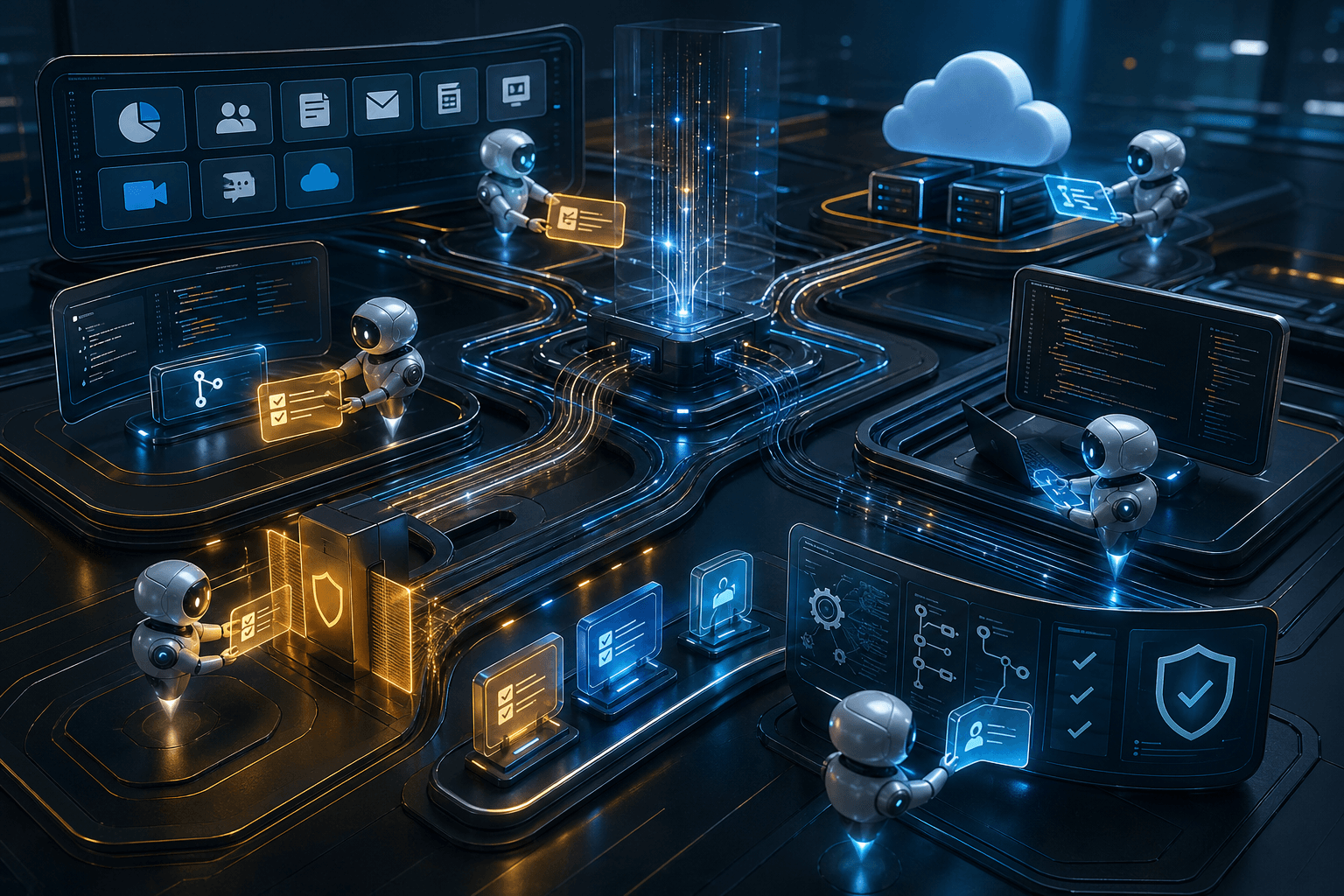
AI productivity has clearly moved from demo to operations: agent frameworks are getting stable APIs, models are gaining native computer use, and MCP is starting to carry both tools and interfaces. Today’s signal is simple: the winners will be teams that build measurable workflows, not just more chatbots.
Today’s AI inputs: production before experimentation
Microsoft Agent Framework 1.0 points to a more mature agent stack: stable APIs, long-term support, and support for multiple models, A2A, and MCP. That makes agent building look more like normal software development: versioned, testable, and ready for governance.
- Key signal: the framework combines ideas from Semantic Kernel and AutoGen in an open SDK for .NET and Python.
- Productivity angle: teams can start standardizing how agents are orchestrated, logged, and reused instead of rebuilding each solution from scratch.
- Next step: choose a narrow internal workflow where two specialized agents can hand work to each other with explicit verification.
Source: Microsoft Agent Framework Version 1.0
Learn this: models are moving into the work environment
GPT-5.4 is positioned as a work model for long professional workflows: documents, spreadsheets, presentations, code environments, tools, and web research. The productivity news is not just stronger benchmark numbers, but the combination of larger context, better tool selection, and native computer use.
- Fact: the API and Codex versions support up to 1 million tokens of context and a native computer tool.
- Fact: OpenAI also highlights better factuality and lower token use than earlier models.
- Practical effect: long tasks can be packaged as plan–execute–verify flows instead of a chain of manual prompts.
Source: Introducing GPT-5.4
Watch or read this week: safe agent sandboxes
OpenAI’s updated Agents SDK shows where development is heading: the agent gets a controlled workspace, file access through a manifest, and sandboxed execution. For productivity teams, this is an important bridge between “AI can write text” and “AI can do work in our systems without losing control”.
- Key signal: the sandbox makes it easier to let agents read files, run commands, and produce deliverables inside a bounded space.
- Risk reduction: permissions, sources, and working directories can be defined before the agent starts working.
- Good test: let an agent analyze a bounded data folder and require filename citations in the answer.
Source: The next evolution of the Agents SDK
Real use case: MCP becomes more than tool calls
MCP Apps shows how tools can return interactive interfaces such as charts, forms, dashboards, and document views directly inside chat. That shifts the agent experience from “text answers text” to workspaces where people can review, steer, and act without leaving the conversation.
- Fact: MCP Apps lets MCP servers expose UI resources that can render in compliant clients.
- Productivity angle: decision support becomes more actionable when the agent shows an interactive view, not just a summary.
- Quadrant check: high potential, medium risk — start with read-only analysis views before connecting write or transactional workflows.
Source: MCP Apps official repository
Short signal: Claude Code hardens for daily operations
Claude Code 2.1.126 focuses less on big headlines and more on the details that make the tool usable in real environments: gateway models in the model picker, project cleanup, OAuth fallback for SSH and containers, and clearer telemetry for skills. It is boring in the right way: agentic developer tools are becoming infrastructure.
- Fact:
claude project purgecan clear project state such as transcripts, tasks, file history, and config entries. - Fact: OAuth codes can be pasted when a local browser callback does not work.
- Productivity angle: fewer interruptions in WSL, SSH, containers, and managed enterprise environments.
Source: Claude Code changelog
Thoughts on how this affects the future
AI productivity is becoming less about individual prompts and more about work design: the right agent, the right tool, the right sandbox, and the right verification. Over the next few months, every organization should pick two or three recurring knowledge workflows and make them measurable: time saved, error rate, quality, and human control points.
The Forge newsletter
Get new articles in your inbox
Pick the topics you care about. No noise, at most one email a week.
We follow GDPR. Unsubscribe anytime.